1. Welcome Hearth.com Guests and Visitors - Please enjoy our forums!
    Hearth.com GOLD Sponsors who help bring the site content to you:
    Jotul Cast Iron Stoves
    Woodstock Soapstone Stoves
    Hearth and Home (QuadraFire and Harman Stoves)
Thread Status:
Not open for further replies.
  1. Mo Heat Minister of Fire

    joined: Nov 18, 2005
    847 posts
    St. Louis, Missouri
    Couldn't find the original DIY ash vacuum thread to give credit, but that's where the idea came from. Who posted that?

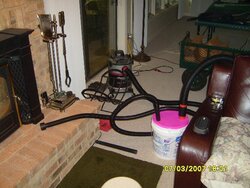
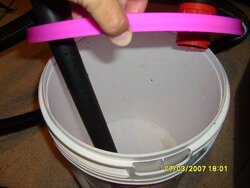
    Anyway, here's my rig (see: photos). I was surprised that I got lucky on both hole cuts. Didn't even need to seal them. At least, it worked well enough.

    I filled this thing up about 1/3 full of water. I might use a little less water, maybe 1/4 full, next time as there was plenty to suspend the amount of ashes I vacuumed up. Could have done a lot more. Nasty water!

    There was only a hint of water on the exit side hose. Maybe someone can suggest something to use to reduce that further?

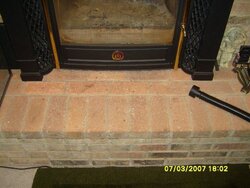
    Mrs. Mo Heat will be surprised to find the hearth finally cleaned. Hey, it's only July. What's the hurry?

    Attached Files:

    #1

    Helpful Sponsor Ads!


  2. karl Minister of Fire

    Reminds me of my college days. I had friend who made a bong that big. He used a 5 gallon water bottle though. I never really thought there would be a legitimate use for one.
  3. senorFrog New Member

    joined: Aug 31, 2006
    285 posts
    Home depot and Lowes sells these, but they are called dry wall dust collectors.
  4. Shane Minister of Fire

    joined: Nov 21, 2005
    1,830 posts
    Casper Wyoming
    I thought the exact same thing Karl except the one in my memory was powered by an asthma machine. How old were you in the 60's Mo. I think I know where your inspiration comes from. Makes me feel kinda lame kicking out 150 for my cheetah.
  5. Mo Heat Minister of Fire

    joined: Nov 18, 2005
    847 posts
    St. Louis, Missouri
    Well, I was old ENOUGH in the '70's, and I had one of those big hooka pipes myself. Man was that thing great at parties! Although, I didn't get my inspiration from that, I got it from a post a year of two ago by someone here at hearthnet. ;)
  6. BrotherBart He Who Moderates

    joined: Nov 18, 2005
    21,949 posts
    Northern Virginia
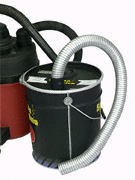
    $35 at Harbor Freight. Goes on sale, like hourly. Metal can with metal mesh filters and hose. I really don't see needing one. By the time I clean my stove the beaches have been crowded for a month so no danger of embers (no matter what stove manufacturers might want to believe) and just using a drywall bag in the Shop-Vac gets'er done.

    http://www.harborfreight.com/cpi/ctaf/displayitem.taf?Itemnumber=40539

    Something nobody ever seems to mention. Leaving ash between and under the firebrick is not a good idea. It absorbs moisture from the air and rusts the bottom of the firebox. Yep, even under the bricks.

    Attached Files:

  7. Mr_Super-Hunky New Member

    joined: May 19, 2007
    149 posts
    BTW:

    I am vacuuming a lot of drywall dust right now and what works out very well is to have a short section of pipe on the discharge side of the vac and then hose clamp a moist tube sock over it. The moist tube sock acts as an additional filter and no more super-fine dust gets through.
  8. elkimmeg Banned

    This might kick it bact to the main forum. What is the #1 reason stove for reduced stove preformance?

    Ash and fly ash clogging up air paths. BB has it right remove as many parts as possible and vac out that stove.

    this is the best way to restore like new opperations. Me I take it one step further I know a PITA but I disconnect the stove.
    I two wheel it out to the driveway and with a blow gun and air compressor It gets blown out then shop vac again.

    this might explain how my 8 year old stove preforms the way it does and yes all easy to remove parts are removed and cleaned

    Maybe that is why my cat combustor and its clean secondary combustion chamber works so well I have a spray painters hood I use.
    that cloud of dust will expose leaks and gaskets that need to be replaced just as good as using a smoke pellet.

    When testing for leaks use a soft rubber ball which I insert in the flue collar, insert the air hose and hand bicycle pump up the soft rubber ball it acts as the plug

    I can presurize the stove where it will blow out air passages and find leaks.. Do not try this in your home it will not gain wife approval
  9. eernest4 New Member

    joined: Oct 22, 2007
    603 posts
    ct
    this info too good to leave buried on page 7.
    harbor frieght no longer stock vacuum ash bucket, i click on link & hf webpage say discontinued item no longer in stock.

    I guess i will just have to go back to using my wet/dry shop vac with the paper filter and keep putting water in the bottom of the shop vac dirt tank to trap any ashes i suck out of my pel pro
    pellet stove.

    PS i just made the last payment on my avatar and the factory warrantee ran out sept 31,07
  10. webbie Administrator

    joined: Nov 17, 2005
    10,939 posts
    Western Mass.
    The filters on most newer shop vac are vastly better than the older ones - as I remember, original units used foam-type, while the current units use the same type (corrugated paper) that the pro chimney sweep vacs use. They also sell an additional filter or cover for drywall dust - which I assume will help with ash.

    Still, that water filter seems to be good ideal. But tell me this - assuming bubbles coming up through the water, what stops the ash from being suspended in these bubbles and then released at the top? it would seem that a method to break up the bubbles into very small ones would be cool....like a screen in the middle of the water....
  11. Mo Heat Minister of Fire

    joined: Nov 18, 2005
    847 posts
    St. Louis, Missouri
    Maybe one of the more industrious hearthnet members will check on ash particle size and compare to available shop vac filters. That would certainly be a reasonable alternative (in cold ash situations), but having the wet filter as a pre-stage still reduces the load on any dry filter.

    As far as bubbles, that's a good question, and one I wondered about myself when building thing. To help with that I implemented the tube sock suggestion (above) and I was hoping that would take care of most of it since the sock is wet and a lot of black stuff sticks to it on the way out. Probably not all of it, but at least some more of it.

    Usage Update:

    I used this thing a couple weeks ago to clean creosote that had fallen beside my bag during chimney cleaning and a half ashed cleaning of the stove insides before the first burn (I'm from the BB school of stove cleaning once a year before burning season, and I still leave an inch of ashes on the grate...). The first usage was only for debris on the hearth and a little bit of ash stuck to the door and in the cat chamber. That first usage came off without a hitch. I think the ash is so light it rushes through the hose and seems to leave nothing in the hose.

    This second usage was to suck up super fine creosote dust from my chimney sweeping that had missed the bag I had taped (the tape let loose) inside the stove, resulting in a pile of creosote on a bypass damper gasket that was going to be a problem if not removed completely. Otherwise, I probably wouldn't recommend using this for suck funky stuff. The result of this cleaning wasn't as good as the last. I had a bunch of black powered creosote left in the first stage hose (the one I was holding and using to suck up the creosote) that I had to rinse out after I was done. That stuff is a nightmare. Like talcum powder. Now I know why sweeps wear black clothes and hopefully respirators.

    I use a long hose between the wet filter and the canister. This puts the shop vac canister, and the exhaust, outside, so particles bypassing both filters get discharged outside. My only worry is that some linger in the canister and exit on a subsequent usage when the canister is in the house. Still, I think I have a leg up on the situation.

    One drawback with the tube sock intermediate filter occurred unexpectedly on the creosote project. The vacuum was powerful enough to suck the tube sock up into the exit hose, which led to a bunch of really funky (as in black) water deposited into the hose, which I eventually deposited onto my 60% wool, Bur bur carpet (oops, sorry, Mrs. Mo Heat). So next time I'm going to make the sock taught instead of letting it dangle into the slurry (yuk). Or maybe weigh it down with something. After "cleaning" the funk water from the hose, or so I thought, and letting it dangle outside for several days to dry, I unexpectedly had a repeat performance of black slurry water onto the carpeting thing (oops, sorry again, Mrs. Mo Heat).

    The first time I used this rig without the tube sock, there was no water accumulation in the hose, so I think the prolapse of the tube sock up into the hose was the culprit, and hope that's not going to happen again. I'll be more careful moving the hose next time, just in case (at the suggestion of Mrs. Mo Heat :red: ).

  12. webbie Administrator

    joined: Nov 17, 2005
    10,939 posts
    Western Mass.
    Mo, time for a job!
    When you start putting all that mind power into ash vacs, it means "back to programming".
  13. Mo Heat Minister of Fire

    joined: Nov 18, 2005
    847 posts
    St. Louis, Missouri
    I have no time for a conventional job. My mind is much too busy solving the unanswered questions of the universe...
  14. WarmGuy Feeling the Heat

    joined: Jan 30, 2006
    483 posts
    Far Northern Calif. Coast
    How could I evaluate whether my stove performance might be reduced by this?
  15. JohnnyBravo New Member

    joined: Oct 15, 2007
    169 posts
    Calgary AB Can
    vac it?
  16. Gooserider Minister of Fire

    Vacuum it out and see if it helps? You should probably be doing an annual or twice annual clean out w/ vac, etc. in any case. It's called you won't be suffering from the problem if you maintain your stove properly...

    Gooserider
  17. WarmGuy Feeling the Heat

    joined: Jan 30, 2006
    483 posts
    Far Northern Calif. Coast
    I periodically vacuum it out thoroughly, but without removing firebricks, etc. Are you saying that I should take out everything that's not welded down and vacuum?
  18. Gooserider Minister of Fire

    As part of the end of season cleanout, possibly. Depends on just what is under the firebricks etc. Do a search for some of the threads where Elk describes what he does to clean his stoves for an example of a really thorough cleaning. Essentially I would say you need to look at your manual for advice on your specific stove, and also look at the parts diagram - figure out where all the air / smoke passages are, and do what it takes to make sure that each one is clear and unobstructed.

    Given that ash is somewhat hygroscopic, and can be mildly corrosive when damp, it is a good idea to remove as much of it as you can at the end of burning season in terms of increasing the life of the stove, let alone the advantages of cleanliness.

    Gooserider
Thread Status:
Not open for further replies.

Share This Page