1. Welcome Hearth.com Guests and Visitors - Please enjoy our forums!
    Hearth.com GOLD Sponsors who help bring the site content to you:
    Jotul Cast Iron Stoves
    Woodstock Soapstone Stoves
    Hearth and Home (QuadraFire and Harman Stoves)
  1. B-Mod New Member

    joined: Nov 29, 2010
    116 posts
    Central WI
    tjnamtiw, glad you find my mod works well for you also. My little quad is just burning happily along, keeping the whole house warm. Your spring mod is working great also. Got some really cold air headed this way again next week. Not much else new here, just dead of winter here, and not much snow. Might actually drag out a snowmobile today to make a few tracks in the yard, lol.............

    Helpful Sponsor Ads!


  2. tjnamtiw Minister of Fire

    joined: Mar 9, 2009
    2,617 posts
    North Georgia
    Yea, it works great, B-Mod. I haven't been on a snowmobile in about 30 years! That used to be fun up in Pa running across corn fields at night about 60 mph hoping and praying there weren't any barb wire fences up ahead!!! Funny how a few beers can make you invincible. ;-P
  3. BradH70 Feeling the Heat

    joined: Feb 13, 2011
    430 posts
    South West NH
    Just ordered some springs. I'm also going to take a look at doing the B-Mod for the convection blower.
  4. BradH70 Feeling the Heat

    joined: Feb 13, 2011
    430 posts
    South West NH
    Got my springs today. Just in time for daytime temps to go back into the 60's and 70's!!! Once I get them in and it is cold enough to run the stove again, I will post a report on results.
  5. Harvey Schneider Feeling the Heat

    joined: Oct 9, 2012
    467 posts
    Southbury, CT
    I worked on high speed centrifuges for a few years. In the process I learned a little about controlling air flow. I want to suggest that you experiment with the amount of spring that you install. Sometimes less is more. You only need to introduce some turbulence in the flowing air. Flowing air can't really be directed where to go. If you add too much resistance to flow near the walls the air will flow down the open center or may not flow at all.
    I one of our designs it only took a twisted piece of aluminum in the flow path to cause the turbulence we needed to get good heat transfer. In another design a wad of stainless window screen was stuffed into the tube. It takes some experimentation to determine the optimum amount of turbulence for good heat transfer. A flat piece of aluminum the width of the tube diameter and a few inches long with a quarter twist should work well in this situation.
    I hope this is helpful.
  6. BradH70 Feeling the Heat

    joined: Feb 13, 2011
    430 posts
    South West NH
    Ok, so I finally had a chance to get the springs into the heat exchanger tubes yesterday. I have to admit that I did not get the results that I had hoped for or the results that some of the other have. What I noticed was a decrease in air flow out of the heat exchanger tubes and an increase in the exhaust temp by about 8 degrees. My stove has 8 tubes versus the 10 tubes of the new stoves so maybe that is were the issue is. Either way, I'm going to remove them and keep the stove stock for now.
  7. SmokeyTheBear Minister of Fire

    joined: Nov 10, 2008
    11,469 posts
    Standish, ME
    Brad,

    Can you post a picture of your stove looking at the tubes with the spring installed. It sounds like you are blocking the air flow and that can happen if there isn't enough of a gap between each section of the coil. Blocking air flow will result in exhaust temperature rise. The goal with the springs is to make the air path both more turbulent and the heat transfer area of the exchanger larger.
  8. BradH70 Feeling the Heat

    joined: Feb 13, 2011
    430 posts
    South West NH
    Hi Smokey. I will get a picture posted tonight. I am pretty sure that the main issue is lower air flow. The springs consume a good portion of the volume of the heat tubes, maybe a spring with less twists over its length would be better.

    Either way, I am going to take them out. My next step is to start to decide on a new control box or not. Mine is dated 2 7 2001 so I know that it is not running the stove nearly as efficiently as the new control boxes do. See thread http://www.hearth.com/talk/threads/quad-castile-combustion-fan.92374/

    The stove does run good. No CSS to speak of and the heat is decent but I think it could be much better if the combustion fan speed was being controlled based on the heat setting.

    And it is about as loud as a freight train, but then again I'm used to my M55 (pre-blower upgrade).
  9. SmokeyTheBear Minister of Fire

    joined: Nov 10, 2008
    11,469 posts
    Standish, ME
    I saw that other thread and didn't want to get into the middle of the control box argument. Your box is likely in the era of we are trying to perfect things.

    I notice whenever I search for Quad Control Boxes there are quite a number of them out there for the various models and even for the same model stove so something was changed and more than one change took place.

    You can see the same thing with other stoves made by other manufacturers(kit builders).

    ETA: I'm following this thread because I can make the same mods to my unit if I feel like it.
  10. openat60 New Member

    joined: Nov 18, 2012
    22 posts
    Catskills Mts Upstate NY

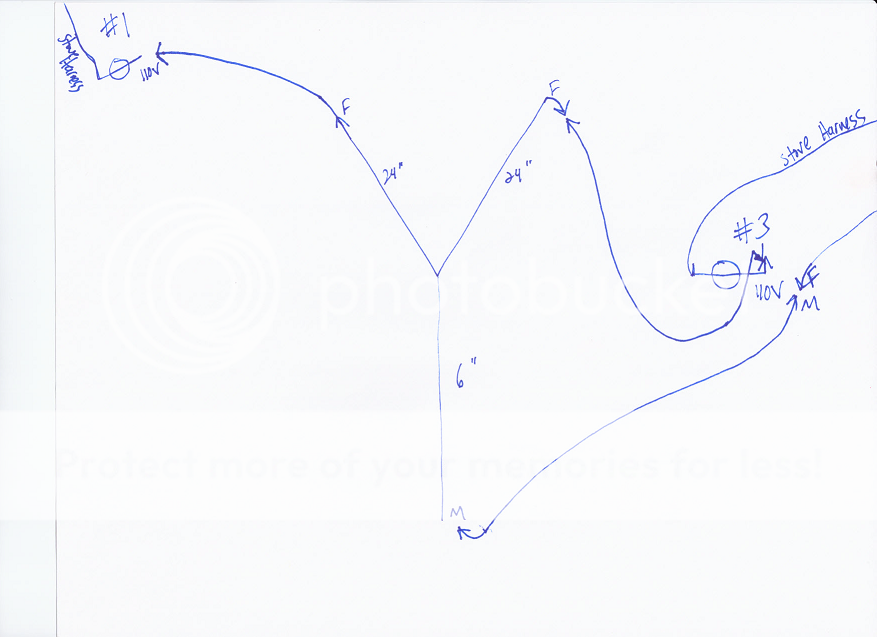
    Does this look right for my own knowledge...and if it is might make it easier for some...Hopefully I decipherd your instructions right.
    [IMG]
  11. tjnamtiw Minister of Fire

    joined: Mar 9, 2009
    2,617 posts
    North Georgia
    That should do it! Basically you are feeding both the convection fan snap disk and the safety snap disk with the same fused 110V supply.
    openat6 likes this.
  12. tjnamtiw Minister of Fire

    joined: Mar 9, 2009
    2,617 posts
    North Georgia
    That was also my aim. I see what Harvey was saying and it may bear some fruit to play around with the turns and other mods. The last thing he was talking about was a twisted piece of metal which is the turbulator that we also have in there! From my studies, they helped the situation too. The best way, in my opinion, to see if you are extracting more heat is to monitor the exhaust temperature at the same exact spot on the exhaust side of the combustion blower under steady state conditions. Both experiments yielded a lowered temperature meaning less heat up the flue.
    SmokeyTheBear likes this.
  13. openat6 Member

    joined: May 18, 2008
    5 posts
    Upstate, Ny
    Just conversation the fuse is else where on the harness, there was no mention of a fuse in your instructions??
  14. openat6 Member

    joined: May 18, 2008
    5 posts
    Upstate, Ny
    And also can you break down the springs and the blower mod for the slower folk in he room one more time. Haha. What they do and what the gain in general.
  15. tjnamtiw Minister of Fire

    joined: Mar 9, 2009
    2,617 posts
    North Georgia
    I was referring to the main system fuse.
    The mods are, I think, pretty well spelled out in this LOOOOONG thread plus there's another thread about 'turbulators' somewhere. ;)
  16. openat60 New Member

    joined: Nov 18, 2012
    22 posts
    Catskills Mts Upstate NY
    haha i was trying to cheat...
  17. tjnamtiw Minister of Fire

    joined: Mar 9, 2009
    2,617 posts
    North Georgia
    I just didn't have the stamina to go all the way through the experiments. :) I'm not saying that what we did is the BEST solution to getting more heat out. It's just A solution that does indeed extract more heat. There very well could be other ways but the smooth tube heat exchangers have been around and UNIMPROVED for probably 50 years in fireplaces. You know the ones that you build the fire on top of and the tubes curve back out into the room. There's a small blower on them.
    Why they couldn't extrude tubes with fins internally and externally is beyond me! What an improvement it would make in efficiency. I guess the Chinese aren't as ingenious as we think they are. They just stole another old idea!
  18. Augmister Feeling the Heat

    joined: Jun 16, 2008
    300 posts
    Socialist Republic of RI
    I have been following this thread for about a year and this is my first comment. I will disclose that I am not an engineer and at best, a poor tinker. The goal is get the most heat out of the stove and into the room with as little loss as possible from the heat generated in the fire box. I agree, at best, some sort of "add on" can achieve an increase of heat transfer, over the stock (current) design, as you are mindful that you only can work with what you have (the current design of the two QF stoves). By adding geometry (springs) to the tube walls you immediately improved your heat transfer from your stove to the room. Here, it is most important that you have the best contact possible between the tube wall surface and your added geometry to achieve maximum heat transfer. There has been a lot of suggestions about the materials for the added geometry (springs) but what is important to remember is that thermal conductivity and heat transfer are not linear. The more thermally conductive the material is, is not directly related to the amount of heat transfer the specific application calls for to move the heat from point A to point B. All you trying to do is moving heat as efficiently as you can from point A to point B. You are not going to move more heat by using copper instead of aluminum or a stainless steel. You just need enough thermal conductivity to satisfy the requirements of your application. If you were to make springs of all three materials and measure them, the temperature measured at ends of tube would be amazingly close. Think of it this way, you are cooling the stove by dumping the hot air that doesn't go up the flue, into a room. You are turning a straight tube into a more efficient heat sink with forced convection. Air flow is the other critical factor (as I see you have learned from the blower mods you have made to the snap disks). If you decrease the airflow by adding resistance, you don't transfer as much heat to the room. I think what you have done is excellent and has made me think of this "experiment" a great deal for a long time. What is the OD (thickness) of the spring material you are using? I am trying to get a metal fabricator I know to produce an insert coil with a smaller OD thickness but more twists which will increase air flow but not decrease the heat transfer surface between coil and tube. Or, keep the same OD of your current spring and decrease the number of coils. I would like to get those metrics and then move ahead with tuning those tubulator rods inside the coils. As you have already seen with the work you have done, tjnamtiw, what seems as a nominal increase in efficiency makes a big difference.
  19. tjnamtiw Minister of Fire

    joined: Mar 9, 2009
    2,617 posts
    North Georgia
    Looking at your diagram again, what you WANT is to feed the #1 snap disk from the INPUT side of the #3 safety snap disk and NOT its output side. This way, if you have an overheat condition and #3 opens up, you will still have the convection fan running to cool the stove down to safe levels. You don't want to feed a snap disk from another snap disk.

Share This Page