
1. Welcome Hearth.com Guests and Visitors - Please enjoy our forums!
    Hearth.com GOLD Sponsors who help bring the site content to you:
    Jotul Cast Iron Stoves
    Woodstock Soapstone Stoves
    Hearth and Home (QuadraFire and Harman Stoves)
Thread Status:
Not open for further replies.
  1. wg_bent Minister of Fire

    joined: Nov 19, 2005
    2,248 posts
    Poughkeepsie, NY
    I picked up some wood the other day, from my usual, friendly neighborhood guy who has lots of Elm (grr), but he had some other wood there that I'm hoping with some help identifying.

    Wood is extremely heavy. Bark looks similar to Ash, but much darker. Inside, the wood has very distinct sap wood - heart wood variations in color similar to Oak, but the heart wood is almost mustard yellow...even slightly greenish in tint. In some places the wood had very dark almost black heart wood, but I'm not sure that wasn't due the the presence of a fair amount of steel nails that were pounded into it. The chain saw cut the stuff like butter (Yes I was careful to avoid the nails!!!) almost like it was Sumac, but it was NOT Sumac. Much too heavy and straight grained more like Ash. It also splits very easy.
    Any clues?
    #1

    Helpful Sponsor Ads!


  2. BrotherBart He Who Moderates

    joined: Nov 18, 2005
    21,954 posts
    Northern Virginia
    I know this probably isn't it but your description is almost exactly like tulip poplar. Really heavy when it is green and feather light after it is seasoned.
  3. Eric Johnson Minister of Fire

    joined: Nov 18, 2005
    5,703 posts
    Central NYS
    Sounds like hickory to me, Warren. Tulip poplar bark looks like ash, but is nothing like you describe inside. Maybe locust. If it smells like fresh green peas when fresh cut green, then it's locust. But my money is on hickory.
  4. SeanD New Member

    joined: Dec 5, 2005
    70 posts
    At first I thought locust also until I read that it cut like butter and split easily. Can't say that about any locust I ever cut.
  5. wg_bent Minister of Fire

    joined: Nov 19, 2005
    2,248 posts
    Poughkeepsie, NY
    No real smell at all, but everything frozen around here. I know a fair amount of shag bark Hickory grows around here, and it's not like that. Bark doesn't seem as thick as a big locust would be. I've got some REALLY big locust rounds, and that stuff has very thick bark that stinks when you strip it.

    This bark is quite thin like a maple or a young White Oak would be. It's clearly Not Maple or Oak though. I'll post a pic when I get a chance.

    Does Hickory have other types besides shag bark type? (man that feels dumb asking that)
  6. BrotherBart He Who Moderates

    joined: Nov 18, 2005
    21,954 posts
    Northern Virginia
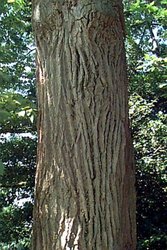
    Tremendous respect for Eric's tree knowledge but have to disagree that the Yellow Poplar, aka Tuplip Poplar, does not look like that inside. Cutting and splitting around fifty in the last few years has given me "inside" knowledge of what they look like. Yelllow straight grain wood with a greenish heartwood and often blackish streaks in the center. The bark is also stringy as hell when it is wet/green.

    Anyway, here is the picture of the bark of one:

    Attached Files:

  7. Eric Johnson Minister of Fire

    joined: Nov 18, 2005
    5,703 posts
    Central NYS
    I've never split yellow poplar, so I defer to my bro, BrotherBart on that. Yellow (tulip) is, as I understand it, a lightweight wood, but that may only be when it's dry. Commercially it's used for furniture framing parts, drawers, etc.

    Shagbark is not the only hickory variety. The kind I'm thinking of has bark similar to ash except that it's much darker and somewhat smoother. Very heavy wet or dry. It almost looks like big striped maple, if you know what that looks like. Inside the sapwood and heartwood are distinct. Being color blind, I'm not sure about the color scheme, but I would say that the heartwood is dark brown while the sapwood is salmon to light brown.

    It's funny, but you learn a lot about various species by "taking them apart" with a chainsaw and splitting maul.

    And, trees are like people in that every one is different and they can have a lot of variety between individuals within the same species. That makes IDing them that much tougher.
  8. BrotherBart He Who Moderates

    joined: Nov 18, 2005
    21,954 posts
    Northern Virginia
    Yeah Eric that darn poplar is deceptive as heck. When we first moved here I had never seen the stuff. Since the builder had knocked down a bunch and stacked the whole trees out back I jumped right on them with the saw. The darn stuff weighed about the same as hickory and split real easy. Six months later I had stack after stack of wood that was lighter than newspaper. Lit in the stove so fast and easy I got concerned about smoking around the stacks. I used it on days when I was home all day and could toss a couple of big splits in every thirty minutes. Burns clean with literally no ash left behind.

    I now keep a cord a year around for starting fires.
  9. elkimmeg Banned

    the greenish tint sure sounds like popular. which is a softer hardwood, Straight grain, splits easilly, Drys very light
    weight. Hell the price was right. I burn the stuff after seasoning. Nothing wrong burning it.
  10. DonCT New Member

    joined: Dec 9, 2005
    609 posts
    Bristol, Connecticut
    Is there a "Bark Book" out there for us not so familiar types? With my luck I would end up cutting down a telephone pole cause it looked like it would burn well :p
  11. Eric Johnson Minister of Fire

    joined: Nov 18, 2005
    5,703 posts
    Central NYS
    Don, they've got books for just about everything.

    Yes, there are books that help you identify trees by the bark, but it's probably one of the most unreliable indicators. Young trees have very different bark than older trees, and ancient trees have completely different bark than just plain old trees. A myriad of external factors affect the appearance of the bark, from disease and weather conditions to soil type, stand stocking, etc. etc. BrotherBart's picture of tulip poplar, for example, could easily be confused with locust or red oak or maple, depending.

    You're way better off trying to ID trees through the leaves or even the shape of the crown.
  12. wg_bent Minister of Fire

    joined: Nov 19, 2005
    2,248 posts
    Poughkeepsie, NY
    Yup, man...Eric I'm impressed with your knowledge of trees...BrotherBart's pic does look exactly like some locust I've got.

    O.k. guys, I'm thinking the stuff I've got is Poplar. I had no idea it grew around here.

    By the way, I looked here:
    http://www.oplin.org/tree/fact pages/tulip_tree/tulip_tree.html

    And this is exactly what the bark looks like, given the greenish tint of the wood (which from wood working everyone knows poplar can be a bit green) now I'm convinced. I think the thing that threw me was how heavy this stuff is.

    Now that I think about how my saw can rip through it, similar to cutting a peice of pine, it all fits. Poplar is is.

    Thanks!!
  13. DavidV New Member

    joined: Nov 20, 2005
    792 posts
    Richmond VA
    Yeah when you said your saw goes thru it easy I didn't think it was hickory. hickory is hard as heck for me to cut with my saw. Others here like poplar. I do not. burns too fast, sparks somewhat, and I have found it to have too much ash. Tulip poplar is what I have run into here and when I am pulling seasoned wood from the pile I throw the poplar as far into the woods as I can. Oh yeah. it also tends to smell like cat pee.
  14. wg_bent Minister of Fire

    joined: Nov 19, 2005
    2,248 posts
    Poughkeepsie, NY
  15. wahoowad Minister of Fire

    joined: Dec 19, 2005
    1,207 posts
    Virginia
    Anybody know a website with good pictures that shows bark and the wood? I am always trying to identify wood and am very new to it.
  16. Corie New Member

    joined: Nov 18, 2005
    2,428 posts
    Halifax, VA
    I searched for a long time and I never came up with a website. I went to Cabela's the other day and they had the Audobon tree book. Has pictures of bark, leaves, and other features, as well as other descriptions.

    i recommend it highly!
  17. roac New Member

    joined: Dec 8, 2005
    227 posts
    Nampa, Idaho
    Just be aware that there is an eastern region version and a western region version of the book. Two different books.
  18. wahoowad Minister of Fire

    joined: Dec 19, 2005
    1,207 posts
    Virginia
    I have a popular tree ID book but it relies a lot on knowing the leaf. I've yet to see anything that has a picture of leaf, bark and wood. These last 2 are often all I have to go on right now.
Thread Status:
Not open for further replies.

Share This Page