1. Welcome Hearth.com Guests and Visitors - Please enjoy our forums!
    Hearth.com GOLD Sponsors who help bring the site content to you:
    Jotul Cast Iron Stoves
    Woodstock Soapstone Stoves
    Hearth and Home (QuadraFire and Harman Stoves)
  1. Uncle Member

    joined: Aug 8, 2011
    55 posts
    Jersey Shore
    I took the advice that I got here n hearth.com to insulate before I get my insert. I am done insulating the walls in which we used roxul r-15 with 6 mill plastic for a vapor barrier and plenty of tyvec tape.

    Now I am ready to do the attic and I'm looking for suggestions, advice and cost estimates.

    Note: The house is in central New Jersey. I'm guessing I have about 800 square feet. We would like to still use a portion for storage space if possible. We plan to live here for the long haul. Also the ventalation is mushroom caps and a temp controled attic fan, there are no sofits.
    #1

    Helpful Sponsor Ads!


  2. semipro Minister of Fire

    joined: Jan 12, 2009
    1,702 posts
    SW Virginia
    Seal any air leaks between the attic and house first at electrical and plumbing passages, etc. with spray foam.
    Then blow in cellulose insulation.

    Another option may be to install spray foam between the roof rafters. This creates a cold roof that mitigates ice dams and allows usage of the attic if you need. You'd still need to seal leaks in the attic.
  3. Highbeam Minister of Fire

    Just remember, batts are for walls. Only a hack would try and cut batts to fit in the attic. Whether to use cellulose or fiberglass is a more difficult question. I used fiberglass since my old house has 1/2" sheetrock and the FG is lighter. The FG is not itchy, and does not burn like cellulose. The cellulose does a better job of air sealing if you aren't able to accomplish that with foam, caulking, and other sealing means.
  4. eclecticcottage Minister of Fire

    joined: Dec 7, 2011
    1,204 posts
    WNY
    Every time I see anything about blown in I cringe. We had that at our Old House. I will say I think it did a bit better than the bats, but it held a smell like nothing else. The Old House was an estate and I don't know if it had been closed up for a while or just wasn't kept up on very well in the end before we bought it. Either way, we had a musty, yucky smell no matter how clean it was for about two years, until we had the electric redone. at that time, we tore out ceilings and some drywall since it all needed replaced anyway. As soon as the blown in was out, so was the smell. And let me tell you, when we opened everything up and exposed it, we felt like heading for the hills.

    We currently have some bat insulation, fiberglass, at the Cottage. It needs to be finished, it's kind of haphazard (it's how we bought it, we haven't gotten that far yet). We do use the space for storage, so we'll insulate between the joists and put plywood down in the middle where we store things, then attic blanket around the outsides where the roof is too low to use anyway. We have gable end vents, no ridge vents or soffit vents.

    BTW, the batts we used fit fine between the ceiling joists.
  5. woodsmaster Minister of Fire

    joined: Jan 25, 2010
    2,225 posts
    N.W. Ohio
    Good points highbeam. Cellulose does not burn though. It may burn your eyes a little when you install it but it's not flamable.
    They add boric acid to keep bugs out and that's what makes your eyes burn. It takes more inches of blown fiberglass to
    equell the same r value as the same inches of cellouse, so whatever you use I'd go to R 50 to R 60.
  6. woodsmaster Minister of Fire

    joined: Jan 25, 2010
    2,225 posts
    N.W. Ohio

    I believe you that it stunk, but I do construction and the nastiest insulation I've torn out is fiberglass. Smelled terrible. I
    think either one can be smelly under bad conditions. If everything is air sealed right you shouldn't be able to smell any thing no
    matter what.
  7. coolidge Member

    joined: Dec 16, 2008
    180 posts
    Maine
    If your going to be there for awhile, have 5" CLOSED CELL foam installed in the rafter bays, you will need a thermal/ignition barrier over the foam. Spend the $$$$ now and keep the oilman away, it will PAY you back in a few years.
  8. Uncle Member

    joined: Aug 8, 2011
    55 posts
    Jersey Shore
    What do you mean by a thermal/ignition barrior? Also how much would 800 sq ft of 5 inch closed cell foam cost ? You guessed right I do have oil..... :sick:
  9. midwestcoast Minister of Fire

    joined: Oct 9, 2009
    1,392 posts
    NW Indiana
    As said, seal all openings to the attic from the living space first. This is your chance to tighten-up the airleaks that will by-pass any insulation you put up there for the next few decades (well, unless you foam the attic floor $...). This work is tedious & labor intensive & often uncomfortable, but costs next to nothing and pays off big. Poke around up there to see what openings you have. Chimney, plumbing vent stack, attic hatch, walls with missing headers, soffits & side attics can be big ones. Electrical are often small, but easy to find & seal.

    IMO blown in is easiest & cheapest to install & performes well for attics where you can just pile it on as thick as you like. I went with cellulose to R-60 in my small attic. You will see claims of Cellulose being a fire hazard, of fiberglass being an itch nightmare, of one or the other being a mold haven... It's all mostly marketing BS when it gets down to it. The one big difference is that cellulose is more dense. That means it's heavier of course, but also SLOWS airflow more. Loose fill cellulose will not seal anything & air will still flow through it, just slower than FG. The biggest positive of the density is that it stops convection currents developing within the insulation. In very cold temps the effective R-Value of FG drops because wam air from the warm side (bottom) can rise through the FG &
    cold air can sink through it, creating a convection loop. This is not the same as air leaks. Cellulose is dense enough to essentially stop this happening. This is from Oak Ridge National Lab testing, not something funded by manufacturers.

    I'd plan to build a raised platform for your storage & blow-in underneath to the same depth as the rest of the attic (frame it up & add plywood after the blown-in). Depth of the joists is not enough insulation & there's no sense having 700 sf of attic at R-50 and let all the heat out from 100 sf of R-25ish (8" joist-bays).

    You say you don't have soffits, or do you mean you just don't have soffit vents? If you have soffits, but no vents you might want to add them now & plan the insulation accordingly. If no soffits I'd look into whether you have enough mushroom vents & add some if needed.
  10. Don2222 Minister of Fire

    joined: Feb 1, 2010
    5,391 posts
    Salem NH
    Here is my story.

    I have a split Entry home built in 1962

    A. Save heat in winter by insulating Attic Floor better and closing up gable vents

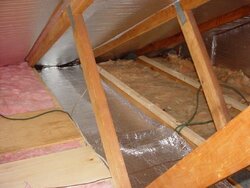
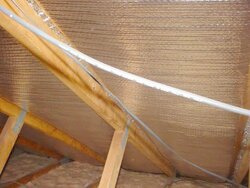
    Pic 1. Rip 2x4s down to create 2x2s and nail them to the 2x4s.
    Remove OLD R7 Stamped ECONOMY Owen Cornings Fiberglass Paper Faced Insulations

    Pic 1. Air seal all holes with Can Foam
    Roll down Reflectix Foil R3.9 then roll down R19 Fiberglass Paper Faced Insulation on top of Foil

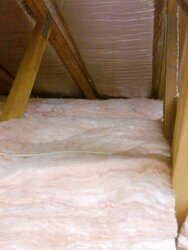
    Pic 2. Criss Cross with Unfaced R30 Fiberglass insulation for a tolal of R53 in floor!

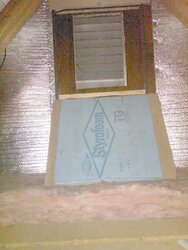
    Pic 3. Since I now have a Ridge Vent and Soffit Strip vent I built doors to close gable vents in Winter
    Also insulate and foil Gable Vent End Walls for better insulation. amazing now by doing tha the paint never peels in the outside triangle where gable vent is because there is no extreeme temp diff between inside and outside!!
    Saves a tremendous amount of heat being sucked out of the house from cold winter winds blowing in!!

    B. Save Air Conditioning cost in summer by reflecting heat and keeping cool in!

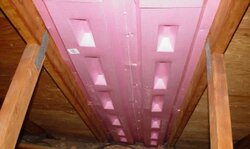
    Pic 4. Staple Rafter vents from soffit all the way up to ridge vent to maintain cool roof!

    Pic 5. Staple Reflectix foil over rafter vents to keep whole house 10 Degrees cooler in summer
    Only need air conditioning if too humind now, never gets too hot!!

    Open Gable vent doors for additional cooling!!

    End result Big $avings in summer and winter!!

    Attached Files:

  11. laynes69 Minister of Fire

    joined: Oct 2, 2006
    1,655 posts
    Ashland OH
    I choose cellulose due to the cost and benefits above over fiberglass. Huge difference after the job in the house.
  12. Highbeam Minister of Fire

    Blow in either FG or cellulose. Blow it very deep. This is a very cheap job to hire out. It is not worth DIY blowing but do spend the time DIYing the air sealing around all penetrations.
  13. Stax Minister of Fire

    joined: Dec 22, 2010
    849 posts
    Southeastern PA
    Anyone know of a decent insulation guy in Southeastern PA?
  14. laynes69 Minister of Fire

    joined: Oct 2, 2006
    1,655 posts
    Ashland OH
    When we checked around, they wanted over 900.00 for the job plus baffles for the attic. I did the job for around 500.00 and it took us about 2.5 hours to blow it in. Airsealing makes a world of difference, very important.
  15. coolidge Member

    joined: Dec 16, 2008
    180 posts
    Maine
    Uncle,

    If you have foam installed in the attic, code requires a thermal/ignition barrier over the foam to protect it from fire. if you have roughly 800 sq ft you should be able to get the 5" and thermal/ignition barrier for around $4500.00.
    yes it is expensive but so is oil, gas, wood. This type of installation will also keep your cooling cost lower and will NOT use any more energy to heat than you use now. Air sealing the attic and installing cellulose is by far cheaper and will do a fine job as mentioned, but not as good as closed cell.
  16. Uncle Member

    joined: Aug 8, 2011
    55 posts
    Jersey Shore

    Are we talking rodants? What kind of blown in did you have?

    PS....Love your Blog...... :exclaim:
  17. NH_Wood Minister of Fire

    joined: Dec 24, 2009
    2,244 posts
    southern NH
    Had attic re-insulated with blown in insulation in fall of 2010 - was a great investment. We have a large house, so it was pretty expensive (about $1700 if I remember), but we brought it up to an R60 and man does the house hold heat. Cheers!
  18. Uncle Member

    joined: Aug 8, 2011
    55 posts
    Jersey Shore
    How much R value do you get with 5 inches? Does the thermal/ignition barrior provide extra R value? I'd like to be at around R 50.
  19. Uncle Member

    joined: Aug 8, 2011
    55 posts
    Jersey Shore
    What kind of blown in did you use? Also how deep to get to R60?
  20. mecreature Minister of Fire

    joined: Dec 16, 2010
    750 posts
    indiana
    Finished a remodel last spring. We had Knauff ECOBATT R-38HD installed in the New and Old attic. Seems to be doing great.

    Nothing fancy. Not sure of the cost. It is a green type product so I am sure we paid for it.
  21. billb3 Minister of Fire

    joined: Dec 14, 2007
    3,068 posts
    SE Mass
    Fiberglass Batts installed by someone who knew what they were doing.

    My sister paid someone to blow cellulose in on her house and the hacks filled everything, including the eaves. They didn't let the knob and tube wiring get in their way, either.
  22. NH_Wood Minister of Fire

    joined: Dec 24, 2009
    2,244 posts
    southern NH
    Funny you ask - I didn't do the job, so not sure how deep it is and I'm also unsure if it was cellulose or fiberglass......hmmmmm........why didn't I ask? Cheers!

Share This Page