


I am using a Simpson Duravent 3" thimble for my Breckwell Big E with a horizontal direct vent. The instructions call for a 7.5" square to be cut through the wall. My question is can anything (insulation) be touching the exterior of the thimble in the wall or does there need to be extra clearance around the outside diameter of the thimble as well?
3" Thimble Install Wall Clearance
- Thread starter bonesy
- Start date
-
Active since 1995, Hearth.com is THE place on the internet for free information and advice about wood stoves, pellet stoves and other energy saving equipment.
We strive to provide opinions, articles, discussions and history related to Hearth Products and in a more general sense, energy issues.
We promote the EFFICIENT, RESPONSIBLE, CLEAN and SAFE use of all fuels, whether renewable or fossil.
You are using an out of date browser. It may not display this or other websites correctly.
You should upgrade or use an alternative browser.
You should upgrade or use an alternative browser.
- Status
- Not open for further replies.
The directions that come with the Simpson Duravent 3" thimble say to cut a 7.5" square. I am not sure the exterior diameter of the thimble will get hot, that's why I am asking about it. There is a void between the exterior and interior plus the void in the double wall vent pipe.
S
smoke show
Guest
Well, the best thing to do is follow the manufacturers guidlines.
I think there is special insulation for heat retardent applications.
I think there is special insulation for heat retardent applications.
The instructions do not mention anything about it. Does the outside diameter of the thimble and flange get super hot? Do I need to use the high temp red RTV around it and the house? Or can I seal that with regular silicon caulk?smoke show said:Well, the best thing to do is follow the manufacturers guidlines.
I think there is special insulation for heat retardent applications.
Pelleting In NJ
Minister of Fire
Last weekend I installed my 4 inch Simpson Duravent Pro wall thimble (the version with the integrated OAK). The instructions say cut a 9 inch square opening. The outer diameter of the thimble (the round part that goes thru the wall) is 7 inches, but because of the OAK tube, the effective dimension needed is 9 inches : This means that the 7 inch thimble tube is right up against the edge of the 9 inch square opening, which is combustable wall material. To support that this is OK, the instructions says that you CAN put insulation against the 7 inch thimble tube. I wanted to double check, so I call Simpson Tech Support. I tell him the thimble model/part number I am using, and he tells me that combustable material can NOT be touching the thimble tube........????? So the confusion continues....
In any case, the allowed clearance from the thimble tube might be different depending on which thimble model you are using (Simpson has three thimble versions for pellet-vent : the regular one for 3 or 4 inch pipe, the integrated OAK version for 3 or 4 inch pipe, and the integrated OAK version with the adjustable/telescoping square/flat OAK duct, in 3 or 4 inch pipe.
In any case, the allowed clearance from the thimble tube might be different depending on which thimble model you are using (Simpson has three thimble versions for pellet-vent : the regular one for 3 or 4 inch pipe, the integrated OAK version for 3 or 4 inch pipe, and the integrated OAK version with the adjustable/telescoping square/flat OAK duct, in 3 or 4 inch pipe.
S
smoke show
Guest
I just got a reply from Simpson tech support for my 3" 3043 thimble:
However I do not remember seeing the framing part in the instructions.
The instructions require you to cut and FRAME a 7-1/2 x 7-1/2 hole. There will be wood framing on all 4 sides of the wall thimble.
Insulation can be on the outside of the framing.
Cut the vinyl siding away from behind the wall thimble so the wall thimble can be attached to the backing material. Use trim (like around your doors and windows) to finish the vinyl siding off.
However I do not remember seeing the framing part in the instructions.

vinny11950
Minister of Fire
who frames their thimble installation?
the DuraVent and ICC pellet call for framing, but I haven't seen it done. Not when the installer installed mine (then again, my installer didn't know much either), or seen it here on the forum posts. Framing means cutting out a much bigger hole in the walls, and then, well, framing, and patching the hole.
For what its worth, I did contact ICC on their pellet thimble and they said it does not need clearance to combustibles. Meaning the outer diameter wall of the thimble can be touching the walls and studs. Though, they didn't say anything about fiber glass insulation inside the walls. I would push that away, just to be safe.
the DuraVent and ICC pellet call for framing, but I haven't seen it done. Not when the installer installed mine (then again, my installer didn't know much either), or seen it here on the forum posts. Framing means cutting out a much bigger hole in the walls, and then, well, framing, and patching the hole.
For what its worth, I did contact ICC on their pellet thimble and they said it does not need clearance to combustibles. Meaning the outer diameter wall of the thimble can be touching the walls and studs. Though, they didn't say anything about fiber glass insulation inside the walls. I would push that away, just to be safe.
I don't think I'd need to cut a larger hole. But I have the "luxury" of doing it in my garage where the interior walls are not finished save for 7/16" OSB which I will unscrew and remove when I do it and reinstall when finished.
For my application it is a 7.5" square hole, then frame that hole. It's pretty easy with 4 pieces of 2x4. Two placed horizontally arcoss between the exsiting wall studs (16"OC) and then the other two vertically between the two you just installed at the proper width (7.5" in between).
For my application it is a 7.5" square hole, then frame that hole. It's pretty easy with 4 pieces of 2x4. Two placed horizontally arcoss between the exsiting wall studs (16"OC) and then the other two vertically between the two you just installed at the proper width (7.5" in between).

I asked the same question when i installed my thimble. I cut a round hole. Round or square that should not matter. What i was more concerned with was insulation touching the thimble.
Several senior members from this forum informed me that insulation around the thimble was fine. The thimble does not get hot. Only slightly warm. Thus my thimble has insulation stuffed all around the inside to keep cold air out.
Several senior members from this forum informed me that insulation around the thimble was fine. The thimble does not get hot. Only slightly warm. Thus my thimble has insulation stuffed all around the inside to keep cold air out.

ghandy131
Member
In MA you need to have a Construction Supervisor License to pull a permit to install a solid fuel appliance. You should check your local code or you might run into a problem with the insurance co.

Hitch
Member
My local hearth shop said I could use regular insulation around the thimble. They did suggest that I remove any paper backing from the insulation. That was last winter, but I still haven't pulled the trigger.
I was thinking about using this stuff, which is advertised to be resistant to heat up to 2150F. However, I'm still concerned about it (not that I have a rational reason, except Murphy's Law ).
).
http://www.lowes.com/pd_89017-1278-RXSS323_4294769460_4294937087_?productId=3285120&Ns=p_product_prd_lis_ord_nbr|0||p_product_qty_sales_dollar|1&pl=1¤tURL;=/pl_Stone+Wool+Insulation_4294769460_4294937087_?Ns=p_product_prd_lis_ord_nbr|0||p_product_qty_sales_dollar|1&facetInfo;=
Roxul 8-Pack 47"L x 23"W x 3"D 0-R Stone Wool Insulation Batts
8-Pack 47"L x 23"W x 3"D 0-R Stone Wool Insulation Batts
Excellent sound absorbency, sound deadening properties
Chemically inert
Does not rot or sustain vermin
Does not promote growth of fungi or mildew
CFC and HCFC free product and process
Friction fit to ensure optimum performance, no sag over the years
Better fit, flexible edge compensates for normal frame variability
Made from natural & recycled materials
User friendly - no fiberglass in product
Easily cut
Easier and faster to install
Water resistant
Non-combustible
Fire resistant - 2150 F
I was thinking about using this stuff, which is advertised to be resistant to heat up to 2150F. However, I'm still concerned about it (not that I have a rational reason, except Murphy's Law
).http://www.lowes.com/pd_89017-1278-RXSS323_4294769460_4294937087_?productId=3285120&Ns=p_product_prd_lis_ord_nbr|0||p_product_qty_sales_dollar|1&pl=1¤tURL;=/pl_Stone+Wool+Insulation_4294769460_4294937087_?Ns=p_product_prd_lis_ord_nbr|0||p_product_qty_sales_dollar|1&facetInfo;=
Roxul 8-Pack 47"L x 23"W x 3"D 0-R Stone Wool Insulation Batts
8-Pack 47"L x 23"W x 3"D 0-R Stone Wool Insulation Batts
Excellent sound absorbency, sound deadening properties
Chemically inert
Does not rot or sustain vermin
Does not promote growth of fungi or mildew
CFC and HCFC free product and process
Friction fit to ensure optimum performance, no sag over the years
Better fit, flexible edge compensates for normal frame variability
Made from natural & recycled materials
User friendly - no fiberglass in product
Easily cut
Easier and faster to install
Water resistant
Non-combustible
Fire resistant - 2150 F

SmokeyTheBear
Minister of Fire
The purpose of the thimble is to provide the required clearance to combustibles, they do so with the channel that the vent pipe goes through, as long as you use the thimble made by the vent manufacturer for the vent pipe you are installing you are safe to have that insulation against the channel.
Your vent is actually triple wall pipe with the third wall just beyond the clearance to combustibles requirements when going through the thimble. You need to make certain that you do not damage that thimble channel.
Please note all of the weasel words in the above.
Your vent is actually triple wall pipe with the third wall just beyond the clearance to combustibles requirements when going through the thimble. You need to make certain that you do not damage that thimble channel.
Please note all of the weasel words in the above.
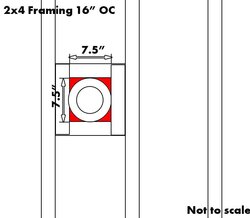
If done properly with the framing around the thimble hole, there won't be much room, if any, to put insulation. The framing itself acts as insulation and your regular insulation goes to the framing as mentioned by the Simpson tech that I posted above. See my illustration below. Essentially the only place you would maybe insulate would be the areas in red, but I think it is really not needed.
Attachments
SmokeyTheBear
Minister of Fire
jmbones said:If done properly with the framing around the thimble hole, there won't be much room, if any, to put insulation. The framing itself acts as insulation and your regular insulation goes to the framing as mentioned by the Simpson tech that I posted above. See my illustration below. Essentially the only place you would maybe insulate would be the areas in red, but I think it is really not needed.
Don't go assuming that what you show there is the same for a thicker wall cavity or that all framing is done with 2" x 4".
Not assuming anything, my garage is 2x4 framing 16" OC, that is why I have it listed. It is also not to scale. But for the Simpson 3" thimbles, it all would be the same. The hole needs to be cut at 7.5" square. Every DuraVent 3" regular pelletvent thimble will have the same space around it (which I have shaded red) and to the inside of the framing. The actual length of the 2x4's or whatever you want to use to frame the hole out do not factor in to the void shaded in red. The 7.5" measurement with the arrows shown on my illustration is the hole size, not the spacing between the studs or the length of the wood used as framing for the hole.
SmokeyTheBear
Minister of Fire
jmbones said:Not assuming anything, my garage is 2x4 framing 16" OC, that is why I have it listed. It is also not to scale. But for the Simpson 3" thimbles, it all would be the same. The hole needs to be cut at 7.5" square. Every DuraVent 3" regular pelletvent thimble will have the same space around it (which I have shaded red) and to the inside of the framing. The actual length of the 2x4's or whatever you want to use to frame the hole out do not factor in to the void shaded in red. The 7.5" measurement with the arrows shown on my illustration is the hole size, not the spacing between the studs or the length of the wood used as framing for the hole.
While it doesn't factor in the void you shaded red the length of the framing lumber in two of the directions does factor into the amount of insulation you can get into the wall cavity, and the depth does as well.

slls
Minister of Fire
This is true. Most new(er) homes are 2x6 framing like mine. Most new(er) attached garages are 2x4 (probably by min code for both). However if one is cutting through a wall for install it is most likely that wall is already insulated. Thus no new insulation is needed no matter what the framing is. Just cut the hole, remove enough insulation to frame the hole and be done.SmokeyTheBear said:While it doesn't factor in the void you shaded red the length of the framing lumber in two of the directions does factor into the amount of insulation you can get into the wall cavity, and the depth does as well.
SmokeyTheBear
Minister of Fire
jmbones said:This is true. Most new(er) homes are 2x6 framing like mine. Most new(er) attached garages are 2x4 (probably by min code for both). However if one is cutting through a wall for install it is most likely that wall is already insulated. Thus no new insulation is needed no matter what the framing is. Just cut the hole, remove enough insulation to frame the hole and be done.SmokeyTheBear said:While it doesn't factor in the void you shaded red the length of the framing lumber in two of the directions does factor into the amount of insulation you can get into the wall cavity, and the depth does as well.
Just be certain you can install that thing in a garage there in PA, up here you do that and you will get he!! from the local CEO's and your insurance company will have a conniption fit and if it isn't removed they will say good bye.

checkthisout
Feeling the Heat
Your piping requires 1" clearance to combustibles so the inside of your thimble generally clears the outside diameter of the pipe by 1-1.5 inches.
Insulation and combustibles are ALLOWED to contact the outside of the thimble.
Insulation and combustibles are ALLOWED to contact the outside of the thimble.
- Status
- Not open for further replies.
Similar threads
- Replies
- 0
- Views
- 421

- Replies
- 5
- Views
- 794
- Replies
- 0
- Views
- 1K
- Replies
- 14
- Views
- 636
