
1. Welcome Hearth.com Guests and Visitors - Please enjoy our forums!
    Hearth.com GOLD Sponsors who help bring the site content to you:
    Jotul Cast Iron Stoves
    Woodstock Soapstone Stoves
    Hearth and Home (QuadraFire and Harman Stoves)
Thread Status:
Not open for further replies.
  1. mikeyny Feeling the Heat

    joined: Nov 16, 2007
    294 posts
    upstate ny
    I was just wondering How much pipe diameter has to do with boiler performance when it is coming in from the outdoors. I know most folks have their pipes buried. I realize there are many different ways to insulate and bury, water proof and protect pipe coming in from an outdoor boiler, but what size is best? my system is 2 inch iron pipe well insulated above ground. Is 2 inch overkill. Is 3/4 too small. It must make a difference in the final performance for a system. The only reason mine is 2 inch is because it was free. The boiler manufacturers must have some recommendation as to what size is right for each system. Is there a simple rule of thumb??
    Mike
    #1

    Helpful Sponsor Ads!


  2. VeggieFarmer New Member

    joined: Jan 22, 2008
    24 posts
    CT River Valley, Vermont
    Mikeyny - I was talking with the Tarm guys today about this, and they recommended either 2" iron or a double run of 1" pex to link an outside boiler to a basement storage tank. Sounds like you're all set with the free iron.
  3. Willman Minister of Fire

    joined: Jan 15, 2008
    589 posts
    Sabattus Maine
    Hi,Long time lurker here. First post of many to come I am sure. My question concerns the actual tapping of the boiler. What size is the Tarm ? My concern is my existing manifold and monoflow loop size. It is 1 1/4" How does one one inch pex loop keep the 1 1/4" fully charged ?
    Will
  4. mikeyny Feeling the Heat

    joined: Nov 16, 2007
    294 posts
    upstate ny
    the tapping on my older tarm are 1 and a quarter. It bush's up to 2 inch and I have no problem that i know of with flow.
  5. solarguy New Member

    joined: Jan 14, 2008
    147 posts
    southern, nh
    It's not a matter on the size of your connections, it's boils down to how many GPM can a specific pipe size accomadate at what velocity so as not to cause interior pipe erosion. Generally if you can be under 7' a second in velocity you'll be safe. The other factor that plays into the equation
    is the fluid & friction loss thru a pipe. Is it 100% water or a gycol mixture, this effects friction loss thru pipe.

    Personally I wouldn't recommend over 12 GPM thru 1" (120,000 BTU's per hr) but the charts do say you can do 25 GPM (250,000 BTU's per hr) thru 1" at 7' a second in velocity however you are out of the "normal design range". We try to engineer everything to be under 3.5' per second.

    I think this is one of the reasons why so many OWB installations limp along, small diameter pipe and water flowing to quickly to transfer the heat.
  6. solarguy New Member

    joined: Jan 14, 2008
    147 posts
    southern, nh
    Made an oops...

    I wouldn't exceed 5' a minute in velocity thru any size pipe for a heating application.
    This would put 1" pipe at 17 GPM, 170,000 BTU's per hr.
  7. sled_mack New Member

    joined: Jan 15, 2008
    139 posts
    Conklin, NY
    Please tell me you meant 5' per second?
  8. solarguy New Member

    joined: Jan 14, 2008
    147 posts
    southern, nh
    dam, I did mean seconds.

    guess it's time to slap on the skis.......
  9. EricV Feeling the Heat

    joined: Oct 29, 2007
    290 posts
    Saranac, NY
    The tappings on my Tarm 40 are 1 1/4".
  10. Bob Rohr Minister of Fire

    joined: Jan 9, 2008
    563 posts
    SW Missouri
    /Pipe sizing depends on a few factors. The type of fluid, the temperature, delta T and acceptable velocities.

    Typically we design around a 20 degree delta T, with water at 180F.

    For continous use hydronic systems 4 feet per second is an industry standard. DHW pipe sizing will often use 8 FPS in their tables.

    Oversizing the pipe will slow the speed of the fluid. Below 2 FPS the fluid will not carry the air along to purge. Target 4 FPS.

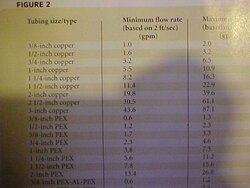
    Here is a table based on 4 FPS, 20F delta T.

    1" pex is commonly used in OWF piping. 7.5 is a safe flow rate for that tube or 75,000 BTU/ hr.

    Some of the PAP, like Kitec has a larger id. Figure 10- 11 GPM through that tube, about the same as 1" copper tube.

    Larger delta t would allow more heat to be moved. if you can design around a 40 delta t you can move twice the energy through the same size tube.

    If you have a buffer tank for example and pull a mix down radiant temperature off that, a 40F delta T can be used.

    I suspect most OWF installations with a 1" pex (one size fits all) and a high head Taco circ probably run some fairly high velocities. if the system is fitting free you may get away with that for some time.

    hr

    Attached Files:

  11. Willman Minister of Fire

    joined: Jan 15, 2008
    589 posts
    Sabattus Maine
    Thanks guys for the answers.Thread is copied into my hydronics folder for continued reference. I am in the planning stage for my boiler set up for next winter. A load of wood coming will be the first actual step to begin my project.
    Will
  12. Eric Johnson Minister of Fire

    joined: Nov 18, 2005
    5,703 posts
    Central NYS
    Welcome to the Boiler Room, Will. What kind of boiler are you planning to get?
  13. Willman Minister of Fire

    joined: Jan 15, 2008
    589 posts
    Sabattus Maine
    Hi Eric, I have been checking out all the gasifier boilers. So far no firm choices. I will keep reading all the threads. IMHO the piping, pumping (distribution), control and storage strategy is what makes or breaks an installation. I have some books by Dan Holohan that describe very well all things hydronic. The boiler is the big item though.
  14. Eric Johnson Minister of Fire

    joined: Nov 18, 2005
    5,703 posts
    Central NYS
    Good move with the Dan Holohan books.
Thread Status:
Not open for further replies.

Share This Page