
1. Welcome Hearth.com Guests and Visitors - Please enjoy our forums!
    Hearth.com GOLD Sponsors who help bring the site content to you:
    Jotul Cast Iron Stoves
    Woodstock Soapstone Stoves
    Hearth and Home (QuadraFire and Harman Stoves)
  1. Chris VanMaaren New Member

    joined: Jan 2, 2013
    3 posts
    I am new to boilers but am looking to put an add on to my oil powered water baseboard heating system and found the Thermo Control boilers. They describe themselves as gasification units but I'm not sure if you guys would agree. Please check out their Model 2000 and tell me what you think.
    http://www.thermocontrolheating.com/

    I like the idea on an add on set up as I wouldn't have to redo the unit and would still have a way to heat the house when I wasn't around to add wood.

    Thanks
    #1

    Helpful Sponsor Ads!


  2. rwh442 Member

    joined: Nov 18, 2008
    128 posts
    Southeast Indiana
    They are natural draft conventional boilers. I have a 2000 model and it has done well for me. Load it about 3.5 times per day depending on wether. My average wood consumption has been about 7.5 - 8 cords per year. 2000 sq ft ranch house, full basement, kept at 71 all year. Boiler is in a 1600 sq ft detached 3 car garage that averages low to mid 60's due to the radiant heat off the boiler. That being said the boiler would use much less wood if it was installed in my basement. I'm happy with the setup though because I play in the garage often.

    I'm sure a gasser is more efficient but cannot put numbers to it. I have no storage other than the 130 gallons the 2000 holds plus lines, expansion tanks and have no issues.

    I initially had issues with overfire or high stack temps but added draft controls four years ago that limit my stack temps to 600 degrees and it has behaved itself since. Just load and walk away - simple.
  3. Chris VanMaaren New Member

    joined: Jan 2, 2013
    3 posts
    Thanks for the info rwh442. Does it burn fairly clean or will it build up creosite in the chimney? I have an old chimney from an oil unit that was in the garage and I could work with that but worry about having 2 turns in the pipe.
  4. Trex83 New Member

    Hi Chris,
    do you have more info on the clearances of your older chimney?
    Is it a Class A or Class B. You may want to install a Class A. Some other members would advise you better than me. The older chimney might be to rusted out or not have proper clearances because the flue of an oil burner is less than a natural draft single stage solid biomass burner. I would go all new with a clean-out adapter and a draft regulator. You will use less wood with a new draft regulator.
    Think about the insurance guy; the next time he walks in your garage... Don't forget to clean oil stains on the cement too!
    Good luck, if you are on this website, you are on the right track!
    Trex83

    ps picture is good too
  5. Standingdead Member

    joined: Oct 8, 2012
    94 posts
    Burnt Hills NY
    I have the model 2500. It's a natural downdraft as well. I go through 8 cords or so a year. It's a good efficient boiler but not a gasser. The 2500 has 175 gallons on board storage. Runs pretty clean with dry wood. Overall I am pleased. It works the way it's supposed to. Does like to eat a lot of wood though ;).
  6. mustash29 Member

    joined: Feb 6, 2012
    32 posts
    SE CT
    I looked into the Thermo stove / boiler units. They have basically the same firebox design, just depends on if it has water pipes in it or an actual water jacket.

    The primary air enters through the front door, around the fuel, and has to go "down" to get around the sloping rear smoke baffle. This sort of makes the gasses flow past the coal bed, not through the bed like an actual downdraft gassifier. The secondary air enters through 2 pipes on either side of the load door and is injected in the rear, near the smoke baffle.

    IMO they act like a gassifier to some degree. If you want to get technical, any EPA stove with secondary burn tubes in the roof is also a gassifier, just in updraft form. IMO a full downdraft design is best since the smoke must go through the coal bed, which is the hottest part of the fire.
  7. rwh442 Member

    joined: Nov 18, 2008
    128 posts
    Southeast Indiana
    Chris,

    Creosote buildup depends on how you burn and wood moisture. If I load the 2000 up at low water temps the chimney will get a dull sound when hit or smacked by hand (highly scientific). If I burn small hot fires at higher boiler water temps (say above 140 degrees, 3 logs) I usually have a clean stack after that type of burn and of course no smoke at all. Tinny sound when checking the stack. I used to clean the chimney a few times each year but once I learned how to run it best and have good seasoned wood I only clean the chimney after the burning season in April. I might get about a half gallon to a gallon of ash and creosote and almost all of that is in the 8" outlet pipe IN the boiler. The chimney buildup is minimal. My chimney is pure vertical straight up - no bends.
  8. Chris VanMaaren New Member

    joined: Jan 2, 2013
    3 posts
    Thanks for the help. I guess the bottom line question for those that have a Thermo Control 2000 or bigger is: would you buy it again or look for something better (less wood etc).
  9. Standingdead Member

    joined: Oct 8, 2012
    94 posts
    Burnt Hills NY
    I would buy one again. It's simple to install and maintain. It works well. It's efficient (1 cord of wood burns down to a 5 gallon ash bucket or so). It's a bit cheaper than a top of the line gasser 4-5k. Yes you burn a little more wood but if you process your own wood that's not a big deal. It's also capable of burning rounds if your so inclined. I never had a gasser so I have no way to compare.....
  10. rwh442 Member

    joined: Nov 18, 2008
    128 posts
    Southeast Indiana
    I would buy one again also. I know a gasser would use less wood but you have to split it smaller too. I would bet the time would come out about the same. If I come across a knotty piece I can't split it becomes an "all nighter" and gets stacked along with the splitters.

    A much simpler design obviously. The fire brick is the only refractory and they are standard stove size - you can get them anywhere.

    A local farmer here has a 1978 Thermo Control stove model (not a boiler) and is looking to first replace it now because it's obviously worn out. My father has the same year stove model, which he quit using about 15 years ago, that the guy wants to buy from him but my father refuses to sell his. So if mine holds up that long (I doubt it but wishful thinking) that would great.
  11. 711mhw Feeling the Heat

    joined: Dec 7, 2010
    341 posts
    Western ME
    I know a guy that sells them, he's a "stand up" guy that says good things about the boiler (expected) but also that the folks that make them are good people, and stand behind their product 100%.
  12. Dan Giesen New Member

    joined: Jan 9, 2013
    3 posts
    What do you mean by draft controls? The only draft control i'm familiar with is the spinning plate within the pipe
  13. rwh442 Member

    joined: Nov 18, 2008
    128 posts
    Southeast Indiana
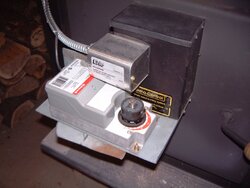
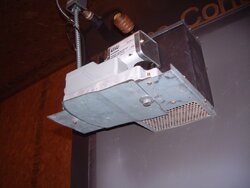
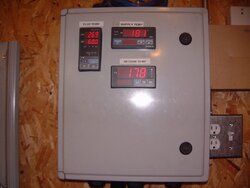
    I inserted a type K thermocouple probe about 2' from the exit of the boiler in the stack and wired it to a PID digital temperature controller. The temperature controller sends a control signal to a damper actuator I mounted to the front of the TC 2000 door. I control the stack temperature to whatever I want - I found 600 degrees is good. The controller has a relay output as well that I set to kill the power to the factory spring loaded damper - I think I have it set to 750 degrees - in case the damper actuator cannot catch the fire in time (it is very slow). See attached pictures.

    I had a chimney fire Christmas Eve about 1 month into running this boiler the first year (about 4 years ago). I was at a nearby family's house. No damage but I swore it would never happen again so I added this protection. Obviously I know how to run the boiler much better now and may not even need the controls but I like the piece of mind.

    Attached Files:

  14. Standingdead Member

    joined: Oct 8, 2012
    94 posts
    Burnt Hills NY
    I am curious what you think caused the fire/over firing. When I bought my stove it came with a stack probe and motorized control to close down the air once the stack reaches 350 or so. At that point the boiler is just drawing air in through the secondaries. I feed the boiler 6 times a day with the only "large" load going in at night (depending on boiler temp and expected overnight low this could be anywhere from 1/4 to 3/4 full. It runs cleanly for me with a little smoke when I reload.
  15. rwh442 Member

    joined: Nov 18, 2008
    128 posts
    Southeast Indiana
    My year one wood was less than ideal. I would always load it totally full. So I must have had some poor burns and creosote buildup. Once that happens the stack limit switch is slow to respond due to any buildup (my guess). I must have had a clean hot burn and then a chimney fire.

    I added the draft controls with the temperature sensor (type k thermocouple probe) internal to the stack. So now it cannot run away.

    I studied the stack limit switch with clean chimney and burns and found that it goes off around 650 degrees internal stack temp with my setup and the gap recommended. It's still in the spring loaded damper circuit so it can shut the draft off as well.

    My burns are much cleaner now. So like any stove or boiler there is a learning curve.
  16. Dan Giesen New Member

    joined: Jan 9, 2013
    3 posts
    I am thinking of buying the model 2000 and putting it in my basement. Would you go with the clad or un-clad model? I'm thinking the insulated model would be better.
  17. Standingdead Member

    joined: Oct 8, 2012
    94 posts
    Burnt Hills NY
    I have the unclad model 2500. Its rated to produce 40k BTU's of ambient heat, putting another 160k of BTU's in the water. When running the boiler at say 140 degrees or more heats my basement to 75-80 or more degrees. To combat this problem I put in a powered vent that pushes the excess heat upstairs. It works very well for me. At seasons start I store 5 cords of mid season wood in the basement. Sitting months in a hot dry basement helps lower the moisture levels. It's also I nice place to "hang out" after working outside most of the day.
  18. rwh442 Member

    joined: Nov 18, 2008
    128 posts
    Southeast Indiana
    As Standingdead said, you will have a warm basement if non-insulated. Mine keeps me detached garage plenty warm and it's around 1600 sq ft. I would probably have it insulated.
  19. Dan Giesen New Member

    joined: Jan 9, 2013
    3 posts
    The model 2000 has about 130 gallons of water in it. In your opinion how well do you think that much water heated to 180 would keep the house warm when the fire dies down? I know there are a lot of variables but i'm just asking what is your real world experience. It would be nice to load up the fire box before work and come home 12 hours later and still have the house warm.
  20. rwh442 Member

    joined: Nov 18, 2008
    128 posts
    Southeast Indiana
    I leave for work right around 6 am. Get home around 5 pm. I loaded it at 120 f this am and the water temp was around 85 when I loaded it again tonight. House was still at 71 degrees but the furnace fan was running. My 2000 is in a detached garage. That being said I am almost positive that if you insulate a 2000 and place it in your basement you would be fine. In any case you can catch up easy if needed.
  21. Standingdead Member

    joined: Oct 8, 2012
    94 posts
    Burnt Hills NY
    With so many variables it's hard to say if you will get a 12 hour burn. I generally max out at around an 8-9 hour burn and using up the on board storage. My unit stores about 100k BTU's of heat. You go through that pretty quickly on a cold night. the unit your considering stores less, about 70k BTU's of heat. Keep in mind I almost never completely fill the box as I would rather have several smaller/hotter/cleaner fires. Even without the jacket I like this unit as the radiant heat is still in the house. With the basement so warm my first floor hardwood floors are usually 75 degrees. This includes the kitchen which makes my wife VERY happy!
  22. maple1 Minister of Fire

    joined: Sep 15, 2011
    1,948 posts
    Nova Scotia
    If you get the uninsulated one, you will likely be finding it too hot in the house when burning when it's not very cold out. I started out this fall deciding to not insulate my newly installed storage tanks until spring. I soon changed my mind on that - it was getting just too darned hot in the basement & first floor. However, I then found it too cool in the basement on cold days. I fix that now by cracking one end of my insulated storage box open a bit when it gets real cold out. So, I'm not familiar at all with the Thermo units, but I'd be tempted to get an uninsulated one, and do some insulating of my own (as long as it could be safely done) that would allow you to easily regulate the amount of heat it radiates or not by maybe pulling an insulation panel off or opening it up or something like that. It is nice on real cold days to have a huge radiator to take advantage of if wanted.

Share This Page