
Electrical Experts: Ceiling light diag

  • Active since 1995, Hearth.com is THE place on the internet for free information and advice about wood stoves, pellet stoves and other energy saving equipment.

    We strive to provide opinions, articles, discussions and history related to Hearth Products and in a more general sense, energy issues.

    We promote the EFFICIENT, RESPONSIBLE, CLEAN and SAFE use of all fuels, whether renewable or fossil.

Ahoragi

Burning Hunk
Jun 12, 2024
139
Western PA
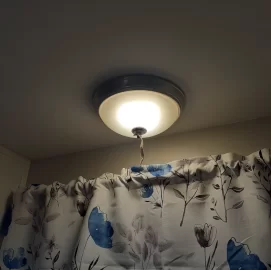
Wondering if you guys can help out with this electrical gremlin with the light above the kitchen sink. Flip the switch and it comes on, nice and bright. Wait about a min or three, it varies, and the light starts flickering or shuts off or both. Wiggle the switch and nothing. Turn it off and on and the light comes back on, rinse and repeat. One thing we notice is that the light never fully turns off, there is a slight glow in the led when the switch is off. This has happened since we moved into this house in 2024.

The wife has been complaining for me to fix this for the past two years. I think I am about to pass the time limit of delaying this before she starts really nagging on me about it.

What do you guys think is the issue or how can I go about diagnosing this?

Wiring? Lamp itself? Switch?

I have a wire tester and I can clearly follow the "hot" wire through the ceiling when the switch is off which we know it's hot already since the LED stays slightly lit. It goes to the similar but larger lamp in the middle of the kitchen. This middle lamp is turned on by a different switch by the door. No issues with this one.
 

Attachments
  • [Hearth.com] Electrical Experts: Ceiling light diag
    20261021_081739.webp
    371.4 KB · Views: 52
  • [Hearth.com] Electrical Experts: Ceiling light diag
    20261021_081742.webp
    270.6 KB · Views: 39
  • [Hearth.com] Electrical Experts: Ceiling light diag
    20261021_081753.webp
    196.5 KB · Views: 34
Last edited:
Is that switch pulling power from the plug or is the plug pulling power from the switch.. If the switch is pulling its power from the plug i would bet that GFI circuit is interrupting it. You should have had a electrician come in when you first noticed it as if that is a loose or bad wire somewhere that is a recipe for a fire. Should have also been caught and noted on the home inspection
 
  • Like
Reactions: stoveliker
Wondering if you guys can help out with this electrical gremlin with the light above the kitchen sink. Flip the switch and it comes on, nice and bright. Wait about a min or three, it varies, and the light starts flickering or shuts off or both. Wiggle the switch and nothing. Turn it off and on and the light comes back on, rinse and repeat. One thing we notice is that the light never fully turns off, there is a slight glow in the led when the switch is off. This has happened since we moved into this house in 2024.

The wife has been complaining for me to fix this for the past two years. I think I am about to pass the time limit of delaying this before she starts really nagging on me about it.

What do you guys think is the issue or how can I go about diagnosing this?

Wiring? Lamp itself? Switch?

I have a wire tester and I can clearly follow the "hot" wire through the ceiling when the switch is off which we know it's hot already since the LED stays slightly lit. It goes to the similar but larger lamp in the middle of the kitchen. This middle lamp is turned on by a different switch by the door. No issues with this one.
I believe those type take a bulb. If so replace the bulb(s) and try that. If the bulb is not replaceable I'd put a newer LED one in. I did that all over my house although now they say the blue light from them is bad for you.
edit - the next thing I'd try is with the power off (beware there could be two breakers), re-do all the connections to the fixture.
 
Last edited:
I believe those type take a bulb. If so replace the bulb(s) and try that. If the bulb is not replaceable I'd put a newer LED one in. I did that all over my house although now they say the blue light from them is bad for you.
edit - the next thing I'd try is with the power off (beware there could be two breakers), re-do all the connections to the fixture.
It's has LED.

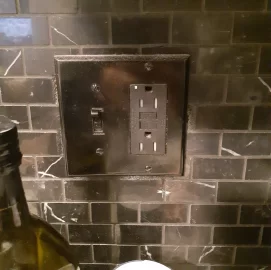
Is that switch pulling power from the plug or is the plug pulling power from the switch.. If the switch is pulling its power from the plug i would bet that GFI circuit is interrupting it. You should have had a electrician come in when you first noticed it as if that is a loose or bad wire somewhere that is a recipe for a fire. Should have also been caught and noted on the home inspection

Weird thing is they flickered as I was messing with it. I am going to check the wiring. From what I can see, the outlet and the light switch are on different breakers. The kitchen light, dining room fan/light, sink light, and hallway light are all on the same breaker.

If I am correct, this particular fixture is still lightly lit when the switch is OFF means the switch is still sending some power to the fixture in OFF mode? Would this be an issue with the switch?
 

Attachments

  • [Hearth.com] Electrical Experts: Ceiling light diag
    20261021_125822.webp
    106.3 KB · Views: 37
Last edited:
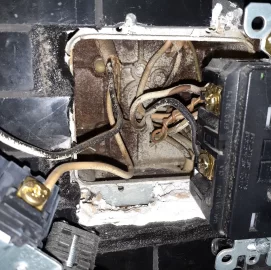
Digging in and I see the ground wire for the light switch is hooked onto the ground wire of the outlet and not the switch itself. Is there a reason they would ground that wire into outlet?
 

Attachments

  • [Hearth.com] Electrical Experts: Ceiling light diag
    20261021_135140.webp
    587.1 KB · Views: 37
  • [Hearth.com] Electrical Experts: Ceiling light diag
    20261021_135130.webp
    300.4 KB · Views: 36
It looks like the switch is fed from the light fixture, not the GFI outlet. Somehow, power is bleeding to the light. With the switch off, there should be no power at the light. The reason could be simple or it could be complicated. It's just in series with the power being fed a the light fixture. This will take some tracing to find the leakage, starting at the light fixture. If all is proper there, then it could be something done wrong at the panel with the neutral or ground on this circuit.
 
It looks like the switch is fed from the light fixture, not the GFI outlet. Somehow, power is bleeding to the light. With the switch off, there should be no power at the light. The reason could be simple or it could be complicated. It's just in series with the power being fed a the light fixture. This will take some tracing to find the leakage, starting at the light fixture. If all is proper there, then it could be something done wrong at the panel with the neutral or ground on this circuit.
If there was something done wrong at the panel, wouldn't that affect all the lights on this circuit?

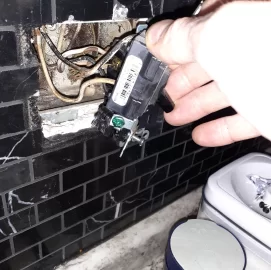
I have a voltage tester. There is no power on either lines at the switch with the switch ON. There is power at both lines with the switch OFF. This does not seem normal in my head but what do I know lol.

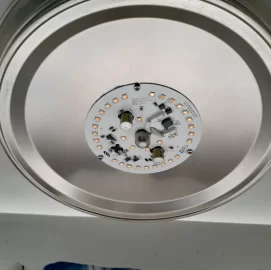
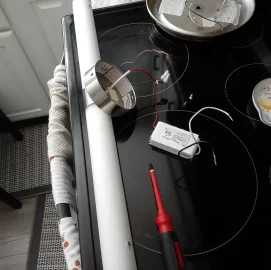
When looking at the led light with the switch off, there are two bulbs that are burnt out and two that are half brightness. Could it just be a bad light fixture?
 

Attachments

  • [Hearth.com] Electrical Experts: Ceiling light diag
    20261021_164329.webp
    181.3 KB · Views: 35
Last edited:
If there was something done wrong at the panel, wouldn't that affect all the lights on this circuit?

I have a voltage tester. There is no power on either lines at the switch with the switch ON. There is power at both lines with the switch OFF. This does not seem normal in my head but what do I know lol.

When looking at the led light with the switch off, there are two bulbs that are burnt out and two that are half brightness. Could it just be a bad light fixture?
I would not worry about no ground to the light switch. The box is metal and the screws that hold it to the box are metal. The light fixture should only be in that switch circuit as it's not a 3 way or 4 way switch. I'd replace the switch.
 
I would not worry about no ground to the light switch. The box is metal and the screws that hold it to the box are metal. The light fixture should only be in that switch circuit as it's not a 3 way or 4 way switch. I'd replace the switch.
Replaced the switch and no change. However I did discover something. With the switch off, I went to install the lamp back on the post and half of the LEDs turned off. I switched it ON and then started tapping the screws holding that LED board to the lamp frame (there are three) and the LEDs flicked off every time I tapped the screw. Yanked on wires and no change. Only tapping those screws sets it off. I believe this is a faulty light fixture. With two of the LEDs burnt out and one brighter than the others plus tapping it flicks it off is a pretty solid diagnosis wouldn't you say?

I also read on Home Depot's product Q&A that someone asked a question regarding theirs staying dim with light switch off and the manufacture stated faulty light fixture.
Replace it. I ordered mine on Amazon.
 
Open the box and look for overstripped wires touching things they aren’t supposed to. Electrical tape can be your friend.
 
  • Like
Reactions: Burnin Since 1991
You could swap the fixtures. If the problem follows the fixture you can rule out wiring.

Does the light never go completely out? Or just stays dim for some minutes? Flickering could be a capacitor.

Edit: maybe get an electrician to take a look. Be safe.
 
Last edited:
You could swap the fixtures. If the problem follows the fixture you can rule out wiring.

Does the light never go completely out? Or just stays dim for some minutes? Flickering could be a capacitor.
Light shuts off but emits a very slight glow from the LED's. You can only see it when it's dark in the room. I think it's called LED ghosting.
 
It could be leakage to ground in the fixture itself. The best way to find out is to test with the fixture removed.
 
  • Like
Reactions: Steveb123321
both 2 lights out, and one super bright,
along with the tap and flicker on the LED board, could it be a cold solder joint, and/or highly resistant solder bridge on the wafer?

If it's new, return and replace it
 
The light glows when it's off due to capacitive coupling across the switch. This is a normal behavior for some of the very cheap LED fixtures due to the very low diode activation voltage.

Flickering is also a normal behavior of cheap LED devices so my suggestion is to replace it with a better one.
 
  • Like
Reactions: semipro
The light glows when it's off due to capacitive coupling across the switch. This is a normal behavior for some of the very cheap LED fixtures due to the very low diode activation voltage.

Flickering is also a normal behavior of cheap LED devices so my suggestion is to replace it with a better one.
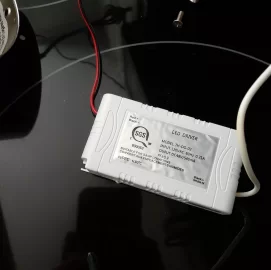
Could be the capacitors on the board. An LED uses DC so there is a power supply of sorts in there.
 
Could be the capacitors on the board. An LED uses DC so there is a power supply of sorts in there.
Could be. When LEDs fail with the flash of death, it's usually because the main filtering cap on the power supply failed.

Some of the cheap lights do just run the LEDs on AC power with the predictable flicker resulting. especially common in the cheap Xmas light strings. Often they do have a current limiting something or other besides just LEDs but not what I would call a "power supply,"

Anyway the glowing while off is a well documented phenomenon, capacitive coupling between the switched hot and neutral creates just enough voltage to make the diodes glow. A more expensive light would have a shunt resistor to prevent that.
 
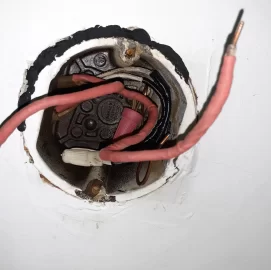
So there are two wires going into the box. The white wires are capped together and the light fixture used the two red wires. Is this what they call daisy chaining?

I have removed a light that is in the bedroom that we never use and going to install it above the sink. It calls for a Live and Neutral but will it still work with this wiring setup?

I am doing this with breakers off and double-triple testing for any power to the lines. I do not want to fry.
 

Attachments

  • [Hearth.com] Electrical Experts: Ceiling light diag
    20261022_110323.webp
    208.8 KB · Views: 27
  • [Hearth.com] Electrical Experts: Ceiling light diag
    20261022_110358.webp
    216.3 KB · Views: 26
  • [Hearth.com] Electrical Experts: Ceiling light diag
    20261022_110401.webp
    134.8 KB · Views: 41
Last edited:
So there are two wires going into the box. The white wires are capped together and the light fixture used the two red wires. Is this what they call daisy chaining?

I have removed a light that is in the bedroom that we never use and going to install it above the sink. It calls for a Live and Neutral but will it still work with this wiring setup?

I am doing this with breakers off and double-triple testing for any power to the lines. I do not want to fry.
They have taped up or heat shrinked those conductors in the ceiling box so be careful as they could have been damaged in the past. The two cables coming into the box will be power, and the cable going too the switch which switches the "hot". The light gets a white and the return from the switch. If you use the same wires as before one should have been white(neutral)
 
I would think that's a switch loop, however fact that the white is passed through to the switch and not the black makes me think maybe they switched the neutral which would not he proper... Or they had the wire colors mixed up.

Either way proceed with caution. Locate the circuit in your panel and confirm which color is used as the hot. While the circuit is live you can use a wiggy to test from each wire to ground in both switch positions and should be able to draw up how the circuit is wired from that information.
At the switch side black and white are correct, but it's good to always check at the light fixture box to make sure they sent the black to the switch. I has a shocking sparking experience working on my garage wiring last year. I turned a light switch off, then went to work on the light box. Sure enough they were switching the neutral, so the box was still hot. I try to get into the habit of using my screw driver to ground out conductors just as a double check.
 
There was one wrap of black wire tape on one of those red loomed wires which I believe was to identify which wire was which.

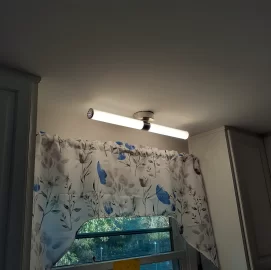
Hooked this up. No flickering, dying, or dimly lit LED's. My meter does not detect any voltage with the switch off.

The mount is not as big as the hole in the ceiling so that is visible. Maybe a little white silicone around it....or get something else. I will see how much it bothers the wife lol.
 

Attachments

  • [Hearth.com] Electrical Experts: Ceiling light diag
    20261022_165938.webp
    211.4 KB · Views: 31