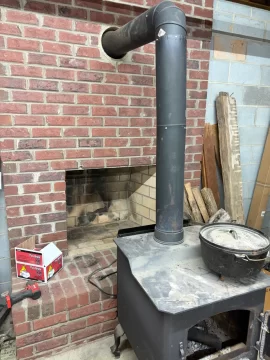

Air/draft issue & downdraft/smoke from cleanout

  • Active since 1995, Hearth.com is THE place on the internet for free information and advice about wood stoves, pellet stoves and other energy saving equipment.

    We strive to provide opinions, articles, discussions and history related to Hearth Products and in a more general sense, energy issues.

    We promote the EFFICIENT, RESPONSIBLE, CLEAN and SAFE use of all fuels, whether renewable or fossil.
Progress! It should run a lot better now.
The thermometer looks like a stove top model, based on the ranges. It appears to be reading at half-way between 300 and 600º or 450º. The temp inside of the flue is about twice that or 900º which is too hot. It should be more like 250- 300º when the air is closed down.
I'm not sure I follow, there is a different type of thermometer for a stovepipe? This is what my stove manual says about monitoring temps: "We strongly recommend that you install a magnetic thermometer on your smoke exhaust pipe approximately 18" above the stove. This thermometer will indicate the temperature of your gas exhaust fumes within the smoke exhaust system. The ideal temperature for these gases is somewhere between275o F and 500o F. Below these temperatures, the build-up of creosote is promoted. Above 500degrees, heat is wasted since a too large quantity is lost into the atmosphere."
 
I'm not sure I follow, there is a different type of thermometer for a stovepipe? This is what my stove manual says about monitoring temps: "We strongly recommend that you install a magnetic thermometer on your smoke exhaust pipe approximately 18" above the stove. This thermometer will indicate the temperature of your gas exhaust fumes within the smoke exhaust system. The ideal temperature for these gases is somewhere between275o F and 500o F. Below these temperatures, the build-up of creosote is promoted. Above 500degrees, heat is wasted since a too large quantity is lost into the atmosphere."
There are magnetic one made for stove tops. Magnetic ones made for single wall stove pipe. And there are probe type that you drill a hole and insert into flue gas stream.
 
There are magnetic one made for stove tops. Magnetic ones made for single wall stove pipe. And there are probe type that you drill a hole and insert into flue gas stream.
This is the thermometer we have, the description says it is for stoves and single wall pipes (which is what our stovepipe is). Is this not what we need?
 
It’s ok. I have two digital thermocouple thermometers with alarms. Rather have the magnetic one than nothing.
 
I'm not sure I follow, there is a different type of thermometer for a stovepipe? This is what my stove manual says about monitoring temps: "We strongly recommend that you install a magnetic thermometer on your smoke exhaust pipe approximately 18" above the stove. This thermometer will indicate the temperature of your gas exhaust fumes within the smoke exhaust system. The ideal temperature for these gases is somewhere between275o F and 500o F. Below these temperatures, the build-up of creosote is promoted. Above 500degrees, heat is wasted since a too large quantity is lost into the atmosphere."
It's bad marketing by Rutland and unsafe. The colored burn zone ranges on your thermometer are for the stove top. A stovepipe thermometer has different ranges or no ranges at all, just temperature. This is because the surface reading on the single-wall stove pipe is about half of the internal flue gas temperature inside of the pipe. Note the temperature range in a proper stove pipe thermometer.

[Hearth.com] Air/draft issue & downdraft/smoke from cleanout

If one ran the stove with the Rutland on the stove pipe, following the green range, there is a strong risk of overfiring the stove, stressing the liner, and wasting fuel.

Here are actual stove pipe thermometers:
 
Last edited:
  • Like
Reactions: EbS-P
Magnolia 2015

Had this stove for 10 or more years
Haven’t used it in 4. Had chimney cleaned several months back. Cleaned stove to chimney metal pipe. Did a test burn the other day and it seemed like it wasn’t drawing in enough fresh air into fire box to burn properly.
Would have the fireplace damper closed do this.
 

Attachments

  • [Hearth.com] Air/draft issue & downdraft/smoke from cleanout
    IMG_0698.webp
    326.7 KB · Views: 11
Is the stove pipe connected to a 6" stainless liner inside of the fireplace chimney? If not, that's the problem. It should not be dumping into a large chimney pipe. That will spoil draft, especially if the fireplace damper is open.
 
Last edited:
Is the stove pipe connected to a 6" stainless liner inside of the fireplace chimney? If not, that's the problem. It should not be dumping into a large chimney pipe. That will spoil draft, especially if the fireplace damper is open.
No liner pipe in chimney.
 
There should
No liner pipe in chimney.
There should be. It will make a major improvement in performance and safety. It should also reduce creosote accumulation.
 
How warm was it outside? The warmer it is outside the weaker your draft will be.
You may have hit on something there. It was warn. I was just trying it out after having the chimney cleaned.
I’ll wait til a colder day and try again.
When I opened the door it pulled in air fine. But with door closing and damper open. Very weak air flow. I was looking to see if something had nested in he damper vent. But all that looked good.
Thanks.