

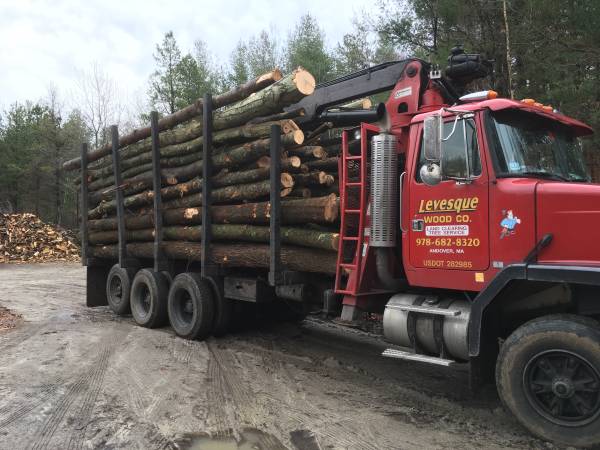
Finding log truck loads

  • Active since 1995, Hearth.com is THE place on the internet for free information and advice about wood stoves, pellet stoves and other energy saving equipment.

    We strive to provide opinions, articles, discussions and history related to Hearth Products and in a more general sense, energy issues.

    We promote the EFFICIENT, RESPONSIBLE, CLEAN and SAFE use of all fuels, whether renewable or fossil.
there are a couple of truckers selling loads in the Boston area on Craigslist.
 
What's the moisuture content?
from AI

The average moisture content of standing trees that have been killed or damaged in a wildfire generally ranges from 27% to 35% (on a dry-weight basis) when measured months after the event, dropping significantly from the 100%+ moisture levels of living green trees. [1, 2]
Key Details on Post-Fire Tree Moisture
    • Time Since Fire: Immediately during a fire, moisture flashes off, and over subsequent months (12 to 52 months post-fire), standing dead trees dry out until their average wood moisture stabilizes roughly between 27.1% and 34.9% depending on environmental exposure. [1]
    • Species Differences: Hardwood species (such as white birch and trembling aspen) tend to retain a higher moisture content (ranging widely from roughly 26% to 53% depending on age and sample height) compared to softwood species (such as black spruce and balsam fir), which dry more rapidly to levels around 17% to 23%. [1]
 
there are a couple of truckers selling loads in the Boston area on Craigslist.

That’s pricey for MA, I see a lot of truck loads on FB marketplace for 5-800. About $100/cord is the “going rate” in MA for hardwood logs.
 
from AI

The average moisture content of standing trees that have been killed or damaged in a wildfire generally ranges from 27% to 35% (on a dry-weight basis) when measured months after the event, dropping significantly from the 100%+ moisture levels of living green trees. [1, 2]
Key Details on Post-Fire Tree Moisture
    • Time Since Fire: Immediately during a fire, moisture flashes off, and over subsequent months (12 to 52 months post-fire), standing dead trees dry out until their average wood moisture stabilizes roughly between 27.1% and 34.9% depending on environmental exposure. [1]
    • Species Differences: Hardwood species (such as white birch and trembling aspen) tend to retain a higher moisture content (ranging widely from roughly 26% to 53% depending on age and sample height) compared to softwood species (such as black spruce and balsam fir), which dry more rapidly to levels around 17% to 23%. [1]
Thanks for posting. I’m getting 15%-38% on 8 year old fire burnt Jack Pine. The 15% stuff is the top 1/2 to 2/3 of the tree with at least 1/2 the bark gone, must be standing. The bottom 1/2 to 1/3 can be as high as 38%. Trees that are sitting on the ground have started to decay and are worthless for firewood. The trees that have fallen but sitting on other trees(not touching the ground) are all over the place on moisture content. Those trees I start cutting in the middle and evaluate from there. The more bark that has fallen off the better the chance of being able to salvage some firewood from the blowdowns.
 
Welp, the husband of one of my wife's housekeepers came thru, he had about 5 cords of logs felled in 2020 that had been sitting under a tarp in their driveway, that he was just never going to get to at his usage rage. $600 had 5 cords delivered, mostly red oak.

I've already started splitting and stacking it, and will plug away at it the rest of this fall, as time allows. This won't be enough to cover my year, but it's a good start. Still looking for other and better sources, for long-term.

After getting no response from a half dozen land clearing companies, I did call a timber company in Lancaster, but also got not reply there. Local sawmills will be next, I guess.

There are plenty of sources for processed wood, but since I already have equipment for processing and enjoy the exercise, I'd ratehr stick to buying logs.