
Pacific Vista Air Intake

  • Active since 1995, Hearth.com is THE place on the internet for free information and advice about wood stoves, pellet stoves and other energy saving equipment.

    We strive to provide opinions, articles, discussions and history related to Hearth Products and in a more general sense, energy issues.

    We promote the EFFICIENT, RESPONSIBLE, CLEAN and SAFE use of all fuels, whether renewable or fossil.

biged99

New Member
Oct 29, 2026
14
Chattanooga, Tennessee
I have a Pacific Vista insert that was installed in 2013. The air intake seems to be blocked since it will not draw air even though the flue is clear. The plenum inside the door is welded. I would like to check the primary air inlet. Also the holes in the plenum. Do I need to remove the fire bricks to do this? Where exactly are the holes?
The insert worked great until recently.
biged99
 
It's not easy to block the primary air, but if the baffle was removed and the secondary air feed tube was not covered, it's possible that filled up with soot and sote. If so, it's going to need to be cleaned out.

When the flue was cleaned, was the chimney cap screen also cleaned?
 
The chimney cap screen was cleaned also. The secondary air feed tube was also checked and was clean. I looked for air holes at the bottom inside the door and above the door and found none. Is this normal?

The damper seems to work properly. I removed the blower assemply and tried to clean around the area around and past the damper using a thin piece of metal. I could see no way to remove the damper assembly itself. Maybe there's a blockage between the damper and the secondary air tube?
 
What’s the temperature down there? I assume you’re pretty warm still in TN.
 
  • Like
Reactions: begreen
Good point. Draft can be much weaker at 60 than at 40.
 
Has anything changed in the house, like sealing leaks? Added big kitchen exhaust fan?
Also check to see if any upstairs windows are open a bit? Or whole house fan ceiling vent that needs to be closed up for the winter?
 
How tall is your chimney? Is there a liner in it? Is it straight up or does the smoke have to go through a couple turns to make it to the chimney.? 40s can still be a little warm if the draft is marginal.

How old is the kindling you’ve been trying to burn? Has it had time to dry out? Sometimes wet wood can keep lit with an open door but stall out once it’s closed.
 
Nothing changed in the house like sealing leaks, etc. The chimney exhaust is about 19 ft. above the base of the insert. It has a liner. The kindling was dry.
If the secondary air inlet to the firebox are the two 1/4" holes in the back, where is the primary air inlet to the firebox?
The insert seems to have slowly gotten harder to start and to keep going over the years. That's one reason I am suspecting a problem with the air intake. Last year even with great wood there was a good bit of charcoal left after burning even if the damper was left wide open.
 
The air intake is easy to spot using a mirror on the floor under the front of the stove. Move the air control to see it's attached to a simple blade valve that moves over the air intake hole.
 
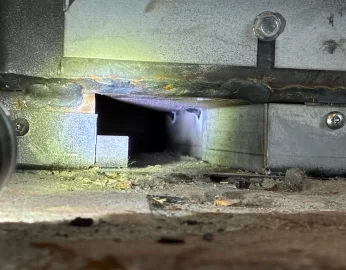
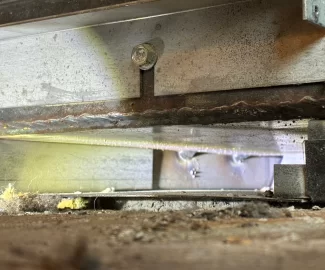
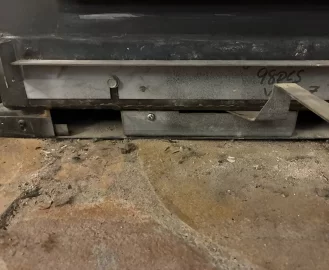
I am confused on seeing the air intake hole. It is not visible from the top since I have removed the two center firebricks and thoroughly cleaned the area. I tried to see it from the bottom using a mirror but their is a sheet metal housing where the damper handle enters which restricts viewing from below.
 
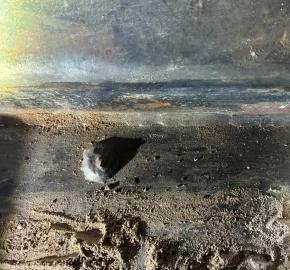
I may have found a problem. There are 2 holes on each side of the housing for the damper assembly. These may be air inlet holes. If so there is a rock hard substance (charcoal?) filling up those holes. Or I might be completely off base.
 

Attachments

  • [Hearth.com] Pacific Vista Air Intake
    IMG_0102.webp
    274.5 KB · Views: 6
  • [Hearth.com] Pacific Vista Air Intake
    IMG_0098.webp
    268 KB · Views: 8
  • [Hearth.com] Pacific Vista Air Intake
    IMG_0096.webp
    684.4 KB · Views: 8
  • [Hearth.com] Pacific Vista Air Intake
    IMG_0097.webp
    423.3 KB · Views: 5
Pictures help a lot. I missed that this is an insert. It looks like it is set up for outside air. Maybe via an ash dump hole in the fireplace floor? Did something change or close this off, maybe sealing up a cleanout in the basement (if there is one).

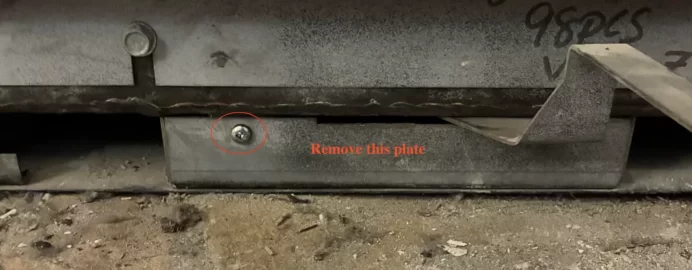
Try this as a solution. Unscrew the circled screw and remove the plate under the air control lever. This will allow the insert to run off of room air. Try running the stove this way and let us know if it works better.

[Hearth.com] Pacific Vista Air Intake
 
Last edited:
I removed that screw but the cover will not come off. I pried it as much as I could without bending it.

I found an installation manual on line for a later model Vista. It said to remove the front piece of the cover to allow room air combustion. My cover does not have a removable front piece.

I was thinking the holes in the side of the cover were to allow air to enter but I remain confused.

Thanks for your help.
 
I was finally able to remove the plate. There was a lot of debris in the horizontal channel routing air to the back of the unit. I cleaned this out and also inspected the vertical channel at the back using a mirror. It was clean. I could not see any openings at the bottom of this channel although there must be and I would like to check these if I knew where to look.

The holes I thought were plugged up were actually welds attaching the horizontal channel to the firebox.

The damper works fine and the hole is not plugged.

I am still confused as to how the inlet air is routed to the firebox and is controlled by the damper.
 
The air control is a simple blade over the intake air hole. Now that the plate has been removed it should be visible with a mirror underneath it. Try a fire when it gets below 50º outside and see how the insert performs with the cover removed.
 
Above the hole is a hollow cavity and I don't see any way for air to enter or leave this cavity. I assume air goes up through this hole but I can find no openings for it to get out.

I do plan on leaving the plate removed.
 
The air movement diagram helps. So air goes up through the hole and is routed around the door to the top where it exits through openings of some sort, probably holes. I assume the holes are on top of the channel above the door since I cannot see any on the side facing the firebox. Can someone with the same model confirm this?

I had cleaned the debris from the channel under the firebox but when I blew air back down through the top of the vertical secondary channel I got a lot more debris which I cleaned again.

I plan on putting everything back together and wait on colder weather to try again. Thanks for the responses,
 
Leave the front cover removed for this testing. It's in the manual for this insert under "Combustion Air".
 
Yes, the model series makes a difference. Thanks for the clarification. Can we assume that that at least one of the side cover plates is removed?