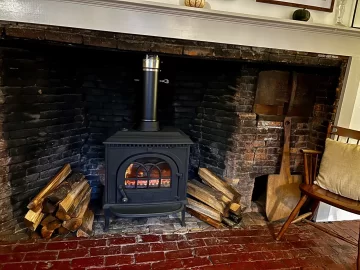

Jotul 8 air intake issue

  • Active since 1995, Hearth.com is THE place on the internet for free information and advice about wood stoves, pellet stoves and other energy saving equipment.

    We strive to provide opinions, articles, discussions and history related to Hearth Products and in a more general sense, energy issues.

    We promote the EFFICIENT, RESPONSIBLE, CLEAN and SAFE use of all fuels, whether renewable or fossil.

LazyMainer

New Member
Oct 2, 2026
12
Maine
Hey Everyone,

I have a Jotul TDIC stove that I acquired used. I actually followed instructions I found here to convert it over to a non cat Euro version of the stove.

So, with that done I painted it and did a few test burns outside to cure the paint. I did notice that when test burning with just a 24" stove pipe that I was not able to cut the air intake down at all. I figured it was due to not being set up and burning out doors. Well, now I have it in the house and hooked up to test more and sure enough I cannot choke the stove down at all.

I have it venting straight up a chimney that is very tall. The chimney has a pretty intense pull so it burns wood fast and I seem to be losing some heat right up the chimney. The slide adjustment for air intake moves very easily with hardly any resistance and after some research I believe it should have more resistance than that if it were working properly.

I have the intake housing off and checked everything over. According to chat gpt etc. I should see broken hardware, springs etc but there's nothing there just the slider. After more AI research ( I know, not exactly the best source) I'm finding that the slider just needs to be compressed tightly against the intake holes to be effective. Those sources are telling me to buy wave washers at the hardware store to somehow create that tension again. Further info and parts info is slim out there for this particular stove so here I am somewhat desperate to get this thing working well now that I have quite a bit of time and some money invested.

One other thing worth noting, I can see where a previous owner has attempted to put stove cement over the tiny intake holes to slow the stove down. That cement was removed easily but tells me the intake hasn't worked correctly for quite some time.

Absolutely any information that you folks can provide would be greatly appreciated! I'm so close to having this set up working correctly!

I can get more photos if needed

[Hearth.com] Jotul 8  air intake issue
[Hearth.com] Jotul 8  air intake issue
[Hearth.com] Jotul 8  air intake issue
[Hearth.com] Jotul 8  air intake issue
[Hearth.com] Jotul 8  air intake issue
[Hearth.com] Jotul 8  air intake issue
 
Is the cat still in the stove and is it in good, active condition?
 
Is the cat still in the stove and is it in good, active condition?
No, the whole cat assembly and the bypass assembly have been removed. Both the cat and it's housing were in bad condition and on top of that the linkage to open and close the bypass was missing completely.
 
Last edited:
Unfortunately, the air regulation may never be right for this stove now that both the bypass and cat have been removed. The 3TD has a different back and baffle that changes the flow of smoke through the firebox.
 
I have replaced the back and the baffle with the Jotul non cat versions. There’s a comprehensive thread here somewhere on how to do that. I’ve also installed the euro 6” flue collar assembly. So, I’d like to think that is not the issue, but I suppose I could be wrong.
 
Did you do to a complete rebuild with new gaskets and cement everything back together? These cast iron stove can develop leaks.
 
I did except for the door gasket which passes the “dollar bill test”. But now as I’m typing that I feel stupid for not doing it anyway.
 
if it passed the dollar bill test all around the circumference of the door, there's no need to replace the gasket imo.
Don't feel stupid. Avoiding unnecessary work is smart, in my book :-) (efficient, in some cases being a better word for lazy, referring to your screen name ;-) !)
 
Well I’m here agonizing over this and tested it again and I found that between the hinges I can pull the dollar bill out easily… not sure if that is my entire issue but probably isn’t helping
 
I see that the flue is tall, but we need more detail. How tall is the flue from stove top to chimney cap? Is there a key damper in the stove pipe?
 
From flue collar to chimney cap is 30 ft plus or minus. It is a straight run. I’m installed a damper in my stove pipe as we speak
That's definitely part of the problem. A damper will help. In some cases of very strong draft, 2 are needed.

Close down the damper once the fire is burning well and see how that goes.
Was the hole for the bypass handle sealed up?
 
I’ve had a fire going most of the day and found the flue damper does very little. I have not sealed the handle, I just left it installed but I’ll explore that.

I’ve been able to keep it running between 450-600 pretty consistently but it takes work and it will run away from you if you are not careful. Im
Definitely going to look further into the slide control, I’m not convinced it is all there and intact…
 
The key damper handle does not get sealed. In the picture it looks slightly open. Close it so that the handle is at 90º to the pipe. Note that these key dampers still permit at least 25% of the flue gases to pass through them by design. That's why two are sometimes needed to throttle very strong draft situations.
 
30 ft is going to be hard to tame. Search the forum. One member bolted stainless plates to the damper to make it more effective. Keep plugging holes. Load it tight. Top down fires help keep the first load in control. Don’t reload on hot coals. Don’t store your wood beside the hot stove. (Story time.. i had a large piece od wry sappy long leaf pine I was saving for a cold night. It spent a few days beside the stove. Loaded it with two or three other splits and it went nuclear. Internals glowing. Don’t do that.).
 
The key damper handle does not get sealed. In the picture it looks slightly open. Close it so that the handle is at 90º to the pipe. Note that these key dampers still permit at least 25% of the flue gases to pass through them by design. That's why two are sometimes needed to throttle very strong draft situations.
Thanks for the reply. Yes I did run it with the damper fully closed with very little change. The stove throws great heat. I kept it cruising along all day yesterday right around 500 degrees and it did great. I just have no confidence in leaving it over night and the burn times are quite low right now.

AI really wants me to believe there is another air inlet under the stove covered by the thin "tin like" cover bolted to the bottom of the stove. I have seen it underneath. It's in place with just one center bolt. I've read I can loosen that and move the plate to cover the hole a bit more. Not sure if that is accurate.

Either way, I think I'm making progress. I'll keep tracking down possible leaks and getting to know how the stove likes to run.
 
If there was a small secondary air intake hole, it would probably be on the back. @D. Hermit is Jotul rebuilder that may have insight.
 
30 ft is going to be hard to tame. Search the forum. One member bolted stainless plates to the damper to make it more effective. Keep plugging holes. Load it tight. Top down fires help keep the first load in control. Don’t reload on hot coals. Don’t store your wood beside the hot stove. (Story time.. i had a large piece od wry sappy long leaf pine I was saving for a cold night. It spent a few days beside the stove. Loaded it with two or three other splits and it went nuclear. Internals glowing. Don’t do that.).
Yes, I'm just going to keep monitoring, keep plugging potential leaks. I'm learning more how it likes to run which has already helped. Good call on not keeping the wood right next to the stove. I was trying to dry some we wood at the time.
 
Yes, I'm just going to keep monitoring, keep plugging potential leaks. I'm learning more how it likes to run which has already helped. Good call on not keeping the wood right next to the stove. I was trying to dry some we wood at the time.
Ok if you have sub par wood it can be hard to control you need the air wide open to get it burning but by the time you think you can turn it down it’s too late. Everything is dry and lights off all at once. I find running the stove using flue gas temps not surface temps helps. You can see exactly when it’s starting to take off and your changes show up in seconds in the flue gas temps. I have an insert that over drafts and a single damper is just barely enough.
 
Ok if you have sub par wood it can be hard to control you need the air wide open to get it burning but by the time you think you can turn it down it’s too late. Everything is dry and lights off all at once. I find running the stove using flue gas temps not surface temps helps. You can see exactly when it’s starting to take off and your changes show up in seconds in the flue gas temps. I have an insert that over drafts and a single damper is just barely enough.
Nice, I like that approach. I'm going to pay more attention to flue temp.
 
  • Like
Reactions: EbS-P