
Thimble for close clearance

  • Active since 1995, Hearth.com is THE place on the internet for free information and advice about wood stoves, pellet stoves and other energy saving equipment.

    We strive to provide opinions, articles, discussions and history related to Hearth Products and in a more general sense, energy issues.

    We promote the EFFICIENT, RESPONSIBLE, CLEAN and SAFE use of all fuels, whether renewable or fossil.

adamt123

New Member
Nov 13, 2026
7
ma
Hi. I just got a lopi Rockport 22’ and am hoping to install into the side of a chimney running up from basement that is currently encased in Sheetrock. The problem is that the wall adjacent to where I’d like the double insulated pipe in is tight and while it could go into the chimney with 6” clearance to the back combustible wall, the actual space is only 18” wide. Lopi suggested I look
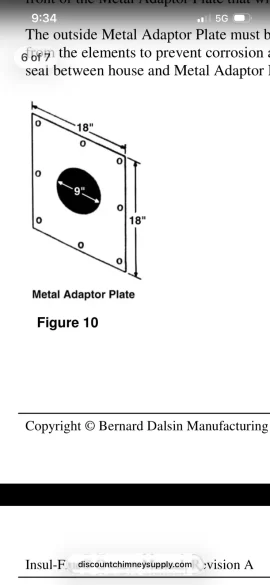
Into the insul flue but that needs 19” for the front plate which is too big my question is can I use some other strategy to go through the dry wall or is there a way to do this with a reduced clearance to the back wall if I remove the drywall covering the brick chimney. I’ll be putting a steel liner in the chimney.
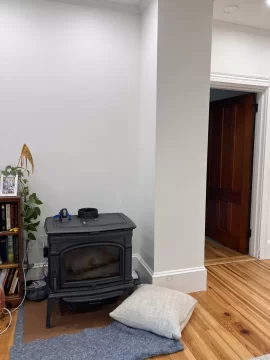
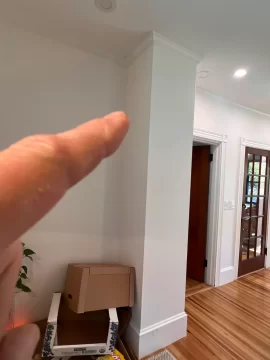
[Hearth.com] Thimble for close clearance[Hearth.com] Thimble for close clearance[Hearth.com] Thimble for close clearance[Hearth.com] Thimble for close clearance
 
Last edited by a moderator:
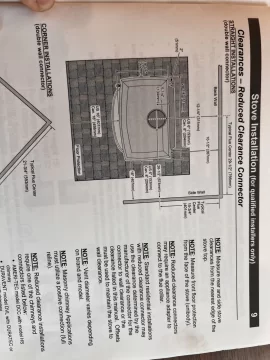
Start with downloading the manual from Lopi's website. A main clearance issue will be for the stove. The Rockport is quite radiant and has higher clearance requirements than some. The chimney will most likely need a 6" insulated liner with a tee snout that connects to the stove pipe. If the brick can be exposed for a safe distance then that will determine the thimble clearance. An Insul-Flue could work. It needs a 15" square frame to attach to. Note that double-wall stove pipe has a 6" clearnance requirement, single wall has an 18" requirement.

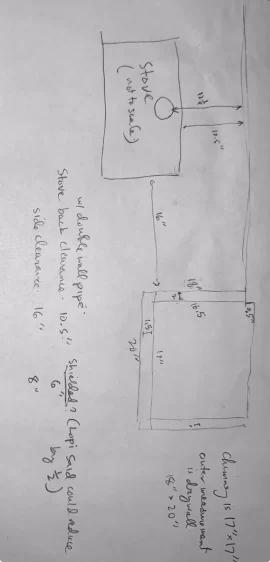
Sketch out a layout that shows the planned location with distances and post a picture of it.
 
Yes. I will need a liner. Also, I was hoping shielding the walls would help me reduce clearances.
As you can see from the sketch I only have 18” on the side I hoping (and wondering if I can) go into. I’m not sure if I can get a 17” square without combustibles there and might not have enough space to get an 18” box to affix the metal adapter plate. I’m not totally clear on the stud placement but can deduce from airspace noted (I hammered a nail through and measured).
1. So my questions are can I use this insul flue?
2. If not, is there another type of thimble that would suite the situation better?
3. Will the double wall piping work with what I’m trying to do?
4.Other solutions? I’d really like to put it in that spot and going in front of the chimney is really sticking out into the room and I assume building a new chimney would be more expensive.

Thanks for your consideration. Here is the link to the insul flue unit I was considering. https://www.discountchimneysupply.com/f/Insul_Flue_Insulated_Thimble.pdf?utm_source=chatgpt.com
 
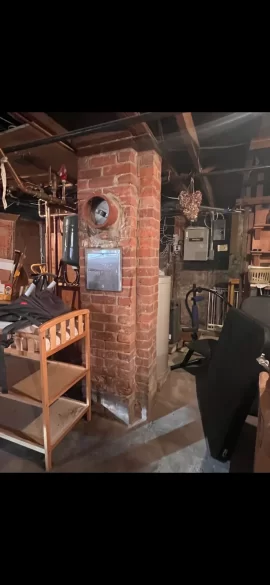
Thank you. I’ll look it up. The picture of the clay pipe is an old hook up for a oil
Burner in the basement. It is 7” open diameter and just under 9” wide on the outside. The inside of the chimney is just brick.
I appreciate the advice!
 
The Heat-Fab Safe-T thimble says it works for walls 4-6.5” thick. Do you think the would work for a situation where the Sheetrock is only 2” from my brick? Thanks again!
 
The Heat-Fab Safe-T thimble says it works for walls 4-6.5” thick. Do you think the would work for a situation where the Sheetrock is only 2” from my brick? Thanks again!
You may need to build out that side wall covering the chimney to use this.

Thank you. I’ll look it up. The picture of the clay pipe is an old hook up for a oil
Burner in the basement. It is 7” open diameter and just under 9” wide on the outside. The inside of the chimney is just brick.
I appreciate the advice!
If it is just brick with no liner then what is the ID of the chimney?
 
There is this suggested option that may work.

[Hearth.com] Thimble for close clearance


@bholler, any thoughts on this approach, assuming a sheet steel plate supports the class A stub?