

Working on building up a non combustible wall behind a site for a new wood burning stove (hearthstone heritage). Steel studs, cement board, tile. Cement board installation instructions specify taping and mudding the joints with fiberglass tape and thinset. Can’t find any indication that fiberglass tape is non-combustible. Wouldn’t want any kind of hazard, but also don’t want extra risk of cracking along the board seams. Or am I completely overthinking this and the tape will be buried under enough thinset not to be a problem?
Non combustible wall-cement board tape
- Thread starter R-Ogre
- Start date
-
Active since 1995, Hearth.com is THE place on the internet for free information and advice about wood stoves, pellet stoves and other energy saving equipment.
We strive to provide opinions, articles, discussions and history related to Hearth Products and in a more general sense, energy issues.
We promote the EFFICIENT, RESPONSIBLE, CLEAN and SAFE use of all fuels, whether renewable or fossil.
You are using an out of date browser. It may not display this or other websites correctly.
You should upgrade or use an alternative browser.
You should upgrade or use an alternative browser.


I'm not sure that formally holds (encasing glass fiber insulation doesn't make it non-combustible either), but I would have no qualms putting glass fiber seam tape in mud there.
I'd go ahead
I'd go ahead
It needs air to burn and won’t be getting any due to encasement is my thought process.I'm not sure that formally holds (encasing glass fiber insulation doesn't make it non-combustible either), but I would have no qualms putting glass fiber seam tape in mud there.
I'd go ahead

Yeah, but that's not the definition of something being combustible or not. A wood stud encased in brick and mortar (think fireplace) is not okay, still combustible, even if no air can't get to it.
Combustible is a material property, not a definition of circumstances (oxygen, ignition source).
Anyway, it's an academic discussion and for the purpose of this case, I see zero risk.
Combustible is a material property, not a definition of circumstances (oxygen, ignition source).
Anyway, it's an academic discussion and for the purpose of this case, I see zero risk.
NEPA_FireOnTheMtn
New Member
The cement board is also entirely embedded with fiberglass mesh. Just sayin'...
With that said, I'm a big fan of the Durock brand.
You also need to watch, my local building supply store sells a brand (PermaBase) that has polystyrene beads mixed in the cement. I don't think that's a good idea around a stove.
With that said, I'm a big fan of the Durock brand.
You also need to watch, my local building supply store sells a brand (PermaBase) that has polystyrene beads mixed in the cement. I don't think that's a good idea around a stove.
I think the issue is that to make the fiberglass into tape you end up coating it with plastic. I think glass fiber itself is pretty non combustible but if you coat it with something like flammable (as in the resin in fiberglass composite for example) that changes things.The cement board is also entirely embedded with fiberglass mesh. Just sayin'...
With that said, I'm a big fan of the Durock brand.
You also need to watch, my local building supply store sells a brand (PermaBase) that has polystyrene beads mixed in the cement. I don't think that's a good idea around a stove.
I had read somewhere about someone using a cement board product that offgassed badly, might have been the permabase stuff you mentioned.
Ugh god the durock is kind of a pain in the ass to work with with the steel studs. The rock on screws aren’t drill point and I blew out a lot of holes in the rock waiting for the plain points to grab in the steel. Ended up pre drilling a lot after a while. It’s up and taped now. Fiddled a bit with figuring out the tile layout.
Yep, cement boards are truly a PITA. I also used them with studs and I am really glad this is done. I also discovered that stuff is very brittle if you use screws too close to the edges and even more in corners so I had to fill a few broken corners with thinset, etc. Hopefully I'll never need to work with that stuff again. 
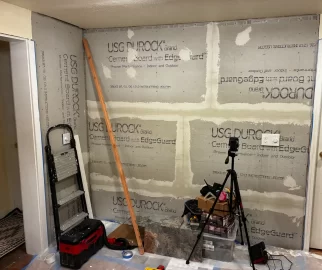
I predrilled my hardiebacker board too. Ruins drill bits too... - well, ruin, dulls.
And thinset to the rescue here too
And thinset to the rescue here too
NEPA_FireOnTheMtn
New Member
I recently installed Durock over 20 gauge studs. I used some scrap pieces of cement board and studs to test on before doing the install. I absolutely recommend pre-drilling pilot holes through the cement board into the steel studs. The PowerPro cement board screws I used bite perfectly and are strong as hell. It's a bit time consuming having to drill each hole, but the results totally make it worthwhile.

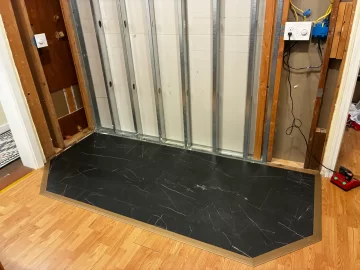
How deep is the hearth? The Heritage is about 21.6" deep. It looks like the nearest combustible will be the sheetrock on the backside of the metal studs. The minimum rear clearance requirement is 8" (with double-wall and rear heat shield) and the hearth needs to extend at least 16" in front of the stove. If the wall depth is ~5", is the hearth depth about 40" deep?
42” IIRC. I do have the manual for the stove that I’ve been through forward backward and upside down but now you’ve got me paranoid that I missed something 😬How deep is the hearth? The Heritage is about 21.6" deep. It looks like the nearest combustible will be the sheetrock on the backside of the metal studs. The minimum rear clearance requirement is 8" (with double-wall and rear heat shield) and the hearth needs to extend at least 16" in front of the stove. If the wall depth is ~5", is the hearth depth about 40" deep?
If it's 42" deep it should be good as long as the stove has the rear heatshield and is connected with double-wall stove pipe.
Yeah, if I had to do it again I would 100% pre drill the holes, or order online to get cement board screws with drill points. It looks like durock sells some under their brand.I recently installed Durock over 20 gauge studs. I used some scrap pieces of cement board and studs to test on before doing the install. I absolutely recommend pre-drilling pilot holes through the cement board into the steel studs. The PowerPro cement board screws I used bite perfectly and are strong as hell. It's a bit time consuming having to drill each hole, but the results totally make it worthwhile.

My old heritage had to have a hearth base with a certain insulation value too. You got that right? Or maybe the newest models don't need that anymore?
New ones are ember protection only.My old heritage had to have a hearth base with a certain insulation value too. You got that right? Or maybe the newest models don't need that anymore?
Just need to rent the big tile saw so I can rip cut those top and bottom rows. Theres only one place in town that I’ve found that rents them, and theirs is out.
NEPA_FireOnTheMtn
New Member
That’s an awesome looking stone tile you chose. Nice work!View attachment 350174
Just need to rent the big tile saw so I can rip cut those top and bottom rows. Theres only one place in town that I’ve found that rents them, and theirs is out.
Similar threads
- Replies
- 12
- Views
- 4K
- Replies
- 3
- Views
- 3K

- Replies
- 10
- Views
- 1K
- Replies
- 7
- Views
- 5K