
On door gaskets and old stoves

  • Active since 1995, Hearth.com is THE place on the internet for free information and advice about wood stoves, pellet stoves and other energy saving equipment.

    We strive to provide opinions, articles, discussions and history related to Hearth Products and in a more general sense, energy issues.

    We promote the EFFICIENT, RESPONSIBLE, CLEAN and SAFE use of all fuels, whether renewable or fossil.

Ashful

Minister of Fire
Hearth Supporter
Mar 7, 2012
20,212
Philadelphia
Hey folks, long time...

So I've got about, what... 120? cords thru this pair of 2015 Ashford 30's, probably 80 cords on the one and 40 thru the other. I've experienced some noticeable reduction in combustor lifespan easily attributed to a leaky door gasket, which is no wonder, I haven't touched them in 11 years of continuous burning.

They honestly still look as nice as the day the stoves were installed, zero damage, I'm not a neanderthal. But obviously compressed, and probably a little stiffer than when new, so I went ahead and ordered new gaskets last spring. And then of course other summer projects took over... and here we are at another burn season.

The gaksets the BK dealer shipped to me are a dark graphite-impregnated thing, which is a surprise, as they claim to use only BK OEM gaskets, and last I knew BK only used white fiberglass gaskets. Maybe they've changed that, which doesn't thrill me, graphite gaskets never seem to hold to adhesive as well as plain white.

The gasket is labeled as 6 feet, the Ashford 30 manual says "do not cut", so we'll see how that works out. Got one for each stove.

I also bought Permatex Red High Temp RTV, figuring that's still the product of choice for this application. I was hoping to do a quick stove and pipe cleaning along with gasket swap this afternoon, before lighting up tonight, but it seems the recommended cure time before heating is a 24 hours.

I guess I'll just burn the current setup and tackle gasket replacement when it gets warm again in a few days. Not a bad thing to have a small fire or two to chase any hornets out of the chimney before I Soot Eater it anyway.

Any tips or tricks you think I might be missing, before executing the door gasket swap? I'll be waiting until I have a new gasekt installed, in fact maybe until I have a test-firing on it, before I even think of installing the new cats. The old ones are at end of life, but still work well enough to get me thru a few shoulder-season burns.
 
There are more than a few posts on the forum about BK Dealers shipping non-BK gaskets to customers. I believe @BKVP recommends having the dealer order them from BK and have them drop shipped to you, to ensure you get proper, approved OEM gaskets.
 
  • Like
Reactions: BKVP and stoveliker
There are more than a few posts on the forum about BK Dealers shipping non-BK gaskets to customers. I believe @BKVP recommends having the dealer order them from BK and have them drop shipped to you, to ensure you get proper, approved OEM gaskets.
I know... I've been on this forum watching those posts for a very long time. And that's what I requested. Even sent a second email to the dealer to confirm they only order OEM gaskets. Of course, that doesn't mean they actually do what they claim.

@BKVP, can you confirm you now ship black 6 feet of graphite gasket for the Ashford 30.1's? If not, you've got a dealer claiming to sell your OEM parts, while substituting something else.

So as you can see in my thread on gasket changing:


The BK gasket isn't white.

I had to cut to length and I'm happy to do so because I think getting it perfect at the factory is asking too much what with all the variability in scrunch or stretch by the installer.

I would for sure use permatex high temp automotive silicone RTV but I would not use red. I used the copper color because it had the highest temp rating but next time I'm using black. Ultra black RTV. I know you don't want some bright red flashing out at you on such a nice stove.

Not sure if the ashford is the same way with the door gasket laying on top of the glass retaining studs but if so this would be a good time to replace the glass gasket too.
 
  • Like
Reactions: Burnin Since 1991
Hey Highbeam,

Yeah, I remember when you did your door, but I'll go back and read that thread to refresh my memory. How many times have you re-done it since 2016?

My original gaskets are most definitely white, but I remember @BKVP saying they were looking to change it back when we had that big rash of "Ashford smoke smell" threads. I suppose this is the one they changed to.

The funny thing is that my gaskets are 11 years old, and a crap-ton of wood thru them, but still look nearly as good as new. it's hard to imagine they leak, but since I've wiped out a few cat's quicker than in years past, it seems the door gasket is a likely culprit.

Between the huge cast door surround and the knife-edge nature of their gasket, I don't think there's any point in even trying to do a dollar bill test. Just to get near the gasket on hinge or top edges, I'd need longer dollar bills.

I haven't changed gaskets since that thread. Haven't even had to adjust the door latch. I think the secret is a deep bed of RTV to overcome those silly nuts and studs in the channel. The gasket I installed is getting some fraying outside of the firebox, just some loose hairs, that makes no difference. Seems that if you do a good job on the install that these gaskets can last quite some time.

Maybe your cat life is just normal now. Running without flames requires the cat to do almost all of the work.
 
My cats have been cracking and falling apart, in years 2 - 3, which is not what you'd expect after surviving initial hyperactivity. BKVP believes door gasket leakage is the cause of it.

But there is some question as to whether a simple latch adjustment might suffice, rather than full door seal replacement. The cam-over force is definitely way down on the door latch, but gasket *looks* good. In fact, the cam over is so light, that if I simply hold the door in with one hand, the latch falls closed, no cam-over feel at all.

So, there's a good chance I'd replace the gasket, and without a door latch adjustment, solve nothing at all.

I did try the dollar bill test again, knowing it just doesn't work on Ashfords. The bill is tight everywhere, but given the many folds in needs to make between gasket and surround, I'm not convinced my inability to withdraw a bill without tearing is any indication of anything, on this particular stove.

I'm leaning toward just adjusting the latches for a better door latch feel, and throwing the new cats into these two stoves.
 
The dollar bill test on any knife edge door seal system is suspect. Even worse with the additional folds required to negotiate the ashford's cast iron cladding.

Not sure why else you would be seeing ceramic catalyst physical damage unless the wood is wet/snow/ice. My dead cats come out after their service life with no physical damage, actually I might see one diagonal crack on this latest cat through one of the three blocks.

With the cost of the gasket being relatively low and after 10 years I think I'd go ahead and replace the door gasket if I were you. I think you'll do a better job than the factory and this will be a one time thing.
 
Do you sorta run your stoves pretty much WOT most of the season?
 
The dollar bill test on any knife edge door seal system is suspect. Even worse with the additional folds required to negotiate the ashford's cast iron cladding.
Yeah, seriously. I almost have to laugh everytime I see someone mention doing the dollar bill test on one of these stoves. There's just no way that works, or gives any useful information, on this stove.

Not sure why else you would be seeing ceramic catalyst physical damage unless the wood is wet/snow/ice.
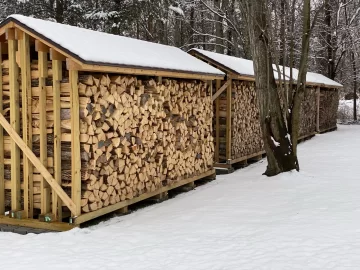
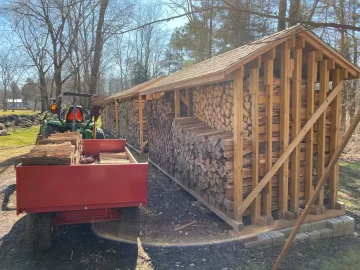
The wood I've been burning is all stacked under a roof 3 - 4 years, double rows exposed both sides. I stopped testing MC% years ago, but can't imagine this stuff is anywhere above 18% - 20%.

You may remember my sheds:

[Hearth.com] On door gaskets and old stoves [Hearth.com] On door gaskets and old stoves

My dead cats come out after their service life with no physical damage, actually I might see one diagonal crack on this latest cat through one of the three blocks.
Mine always did in the past, as well. Last year was the first time I observed physical damage, hence the assumption of door seal issues.

With the cost of the gasket being relatively low and after 10 years I think I'd go ahead and replace the door gasket if I were you. I think you'll do a better job than the factory and this will be a one time thing.
Still on the fence with this. Original gasket still looks good, but cam pressure is very low. Gasket has deep knife-edge impression on hinge side, but only very light impression on latch side. Thinking that simply snugging up the latch may get things where they need to be, without the delay and work of re-gasketing.

I'll make the time to do a new gasket if really needed, but I'm pretty busy with other things these days, so better avoided if not necessary.

Do you sorta run your stoves pretty much WOT most of the season?
One of each. One stove is pretty much always run at a rate of 1 full load / 24 hours, but the other often does run rull loads WOT. The funny thing is, I seem to recall seeing damage to the cats on both stoves last year. I'd need to hunt my old posts or PM's to confirm that, or wait until I get around to removing them again, but that is my recollection. In fact, one was so far gone that I set it out in the garage and re-installed an old one I'd had laying around from prior years, to get thru the remainder of last year. Of course I can't remember which stove that was on, now. ;lol
 
Follow-up: I tightened the latches on both Ashford 30's, and I'm convinced they're sealing much better now. Much easier to get back to "black box mode" now, particularly noticeable on the one harder-used stove.

I'm waiting on a warm day to do my annual cleaning, usually happens each October, and will replace the combustors in both stoves when I do. We'll see if the new ones hold up a little better than the last pair.

For anyone attempting a latch adjustment, I'll just say, "a little goes a long way"! I should have taken before/after measurements, but having failed to do that, I can estimate movement by the shadow of the fastener marks on the latch plate. It looks like I moved the latch maybe 0.09" on the heavily-used stove, and that was definitely too much. I could barely latch it for the first day or two, to the point where I was thinking maybe I'd take it back apart to ease off a bit... but it eventually seated in to a happier place on its own. The second latch was moved less, maybe 0.06", and that provided a more reasonable / moderate latching pressure.

I hope I'm not warping a door by having an overly-tight latch, but I suspect the gasket has just re-formed as needed around that knife edge, is all that's happened.
 
  • Like
Reactions: Dieselhead and Tron