


Thermocouples, Cat and Pipe Monitoring, Progress Hybrid
- Thread starter John Lehet
- Start date
-
Active since 1995, Hearth.com is THE place on the internet for free information and advice about wood stoves, pellet stoves and other energy saving equipment.
We strive to provide opinions, articles, discussions and history related to Hearth Products and in a more general sense, energy issues.
We promote the EFFICIENT, RESPONSIBLE, CLEAN and SAFE use of all fuels, whether renewable or fossil.
You are using an out of date browser. It may not display this or other websites correctly.
You should upgrade or use an alternative browser.
You should upgrade or use an alternative browser.
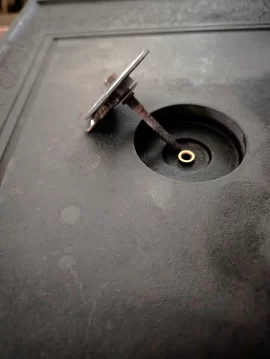
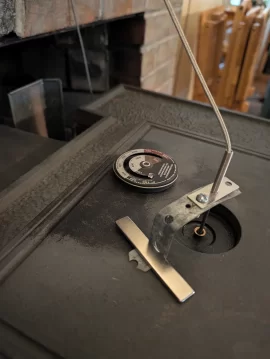

I haven’t pushed the stove yet this year. The highest cat temp I’ve seen is a little over 1200 at a higher setting just below #1 but I turned the air down to about .5 and cat temps drop and cruise around 900-1000 with a dull red cat. At 1200 the cat was a bright orange/red but not intensely. I’m sure the temp could go higher.Can the tip of your bent probe reach past the edge of the cast iron cat frame, or is it a little short of actually getting over the cat itself (assuming you're using the ceramic cat with cast frame.) My Condar (not bent) is 8" actual probe length not including dial and spacer, and it clears the back edge of the cast cat frame, with maybe 3/4" or so over the cat face.
I wouldn't think much influence from radiation to the bi-metal strip; Has to be a good 1/2" away from the cast iron flue collar assembly, and that's probably running ax, no?
True, dull red is about 900, but the 1000 that Todd reports when the cat is "bright" is way low; more like 1300-1400 or more depending on how bright "bright" is. If it's bright orange, almost pushing yellow, it's past 1500 for sure.
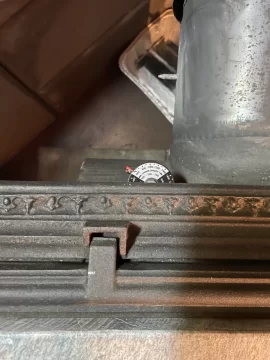
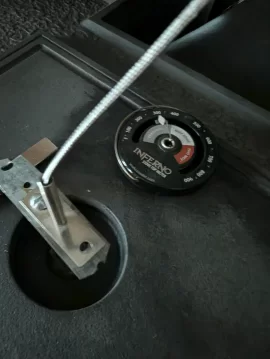
Here’s a pic of the probe in my pending sale Fireview. It’s not ideal because it’s not centered like I’d like but it still gives me good info. Condar told me 8.5” probe is as long as they have in stock but you could special order a 10” . I don’t remember the cost but it wasn’t worth it to me.
One of these days I’ll burn a hotter fire and see how high the probe goes. I almost always burn just about fully closed and I’ve never seen the steel cat take off temp wise in black box burn like the previous ceramic cats I’ve had. These new steel cats seem to have more control relative to air setting.
Attachments
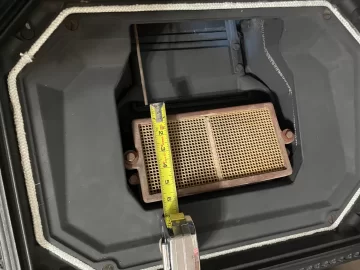
Interesting observation about the stainless cats being more controllable than ceramic. That fact might make me a little more comfortable shelling out the big bucks for a steelie as opposed to a ceramic. Now, I've got a steel cat in the Dutchwest, and I have to cut the air to almost all the way closed to keep the cat from going high. I have the alarm on the Auber set at 1450, and it will go off if I have the air open a little too much. But it's a good possibility that the stove is leaking air, and some seams need to be re-cemented.I haven’t pushed the stove yet this year. The highest cat temp I’ve seen is a little over 1200 at a higher setting just below #1 but I turned the air down to about .5 and cat temps drop and cruise around 900-1000 with a dull red cat. At 1200 the cat was a bright orange/red but not intensely. I’m sure the temp could go higher.
Here’s a pic of the probe in my pending sale Fireview. It’s not ideal because it’s not centered like I’d like but it still gives me good info. Condar told me 8.5” probe is as long as they have in stock but you could special order a 10” . I don’t remember the cost but it wasn’t worth it to me.
One of these days I’ll burn a hotter fire and see how high the probe goes. I almost always burn just about fully closed and I’ve never seen the steel cat take off temp wise in black box burn like the previous ceramic cats I’ve had. These new steel cats seem to have more control relative to air setting.
So your probe tip is about an inch behind the back of the cat frame...how high above the back of the cat frame is it? I have to think that in that position, your probe is reading the exhaust temp downstream from the cat, and will read substantially lower than a probe tip that's at the recommended 1/2" from the cat face, and being radiated by the glowing cat.
It would be interesting to compare readings from a digital thermocouple probe to the analog probe. As I've said, I'd be happy to return the Auber thermometer and probe that you gave me a couple years back, when you went to the Jotuls and thought you weren't coming back. 😏 I've yet to meet the stove nerd who didn't think that another meter and more information would be a bad thing. 🥸😆
I also have a couple of 8" Condar probes that I'm not using since I set up my SIL's and BIL's Fireviews with Aubers. I'll send you one so you can get the probe tip over the face of the cat. That would tell us if indeed the long analog probes are unable to transmit the true cat temp all the way back to the dial, or if this is another one of my theories that turns out to be hogwash. 😆
I don’t think it’s reading “substantially “ lower than it would if it were closer but if you’d like to send me a 8” straight Condar probe feel free, we will test your theory. Don’t worry about the Auber, I never liked the looks of the wire and couldn’t hide it very well in this install. I’ll burn a hotter fire Sunday as well to see how hot she can get.Interesting observation about the stainless cats being more controllable than ceramic. That fact might make me a little more comfortable shelling out the big bucks for a steelie as opposed to a ceramic. Now, I've got a steel cat in the Dutchwest, and I have to cut the air to almost all the way closed to keep the cat from going high. I have the alarm on the Auber set at 1450, and it will go off if I have the air open a little too much. But it's a good possibility that the stove is leaking air, and some seams need to be re-cemented.
So your probe tip is about an inch behind the back of the cat frame...how high above the back of the cat frame is it? I have to think that in that position, your probe is reading the exhaust temp downstream from the cat, and will read substantially lower than a probe tip that's at the recommended 1/2" from the cat face, and being radiated by the glowing cat.
It would be interesting to compare readings from a digital thermocouple probe to the analog probe. As I've said, I'd be happy to return the Auber thermometer and probe that you gave me a couple years back, when you went to the Jotuls and thought you weren't coming back. 😏 I've yet to meet the stove nerd who didn't think that another meter and more information would be a bad thing. 🥸😆
I also have a couple of 8" Condar probes that I'm not using since I set up my SIL's and BIL's Fireviews with Aubers. I'll send you one so you can get the probe tip over the face of the cat. That would tell us if indeed the long analog probes are unable to transmit the true cat temp all the way back to the dial, or if this is another one of my theories that turns out to be hogwash. 😆
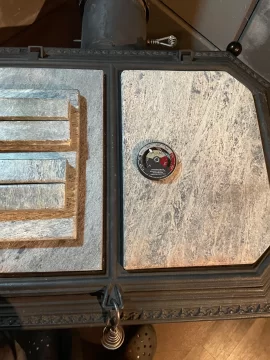
I mostly just use the internal stack temp for guidance, it really tells me everything I need to know but the cat temp is another extra tool to fine tune things. Stove top temp is a lot different now that I stacked more stone on top, probably reads a 150+ degrees less than before.
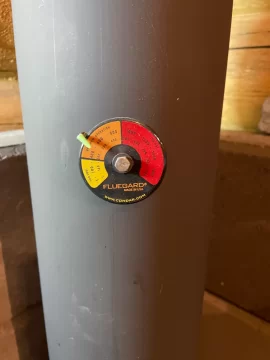
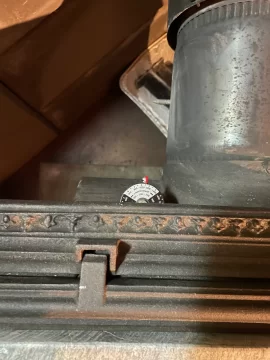
I let it burn at #1 for an hour which I consider a pretty high burn. Flue stayed pretty steady at 600 while cat temp peaked at 1200. Stove top hit 400 after an hour but I have extra stones on top so I’m sure it would have been closer to 600 without it. I usually turn it down from 1 after 15 min but wanted to push it a bit.
Attachments
Nice. The Fireview is designed to be able to do low air cat only fires. Black box is fine for you. I have no idea about the Progress, what the cat will do with a black box. I’m hoping it’s fine, can’t wait to find out. Last season it went black box sometimes for sure. Nothing has warped yet.
But it’s just crazy to me that nobody knows that I can find, nobody I can find has monitored the cat, and Woodstock won’t say anything about it.
I’ll start to fire the stove in a couple of days, maybe even heading into consistent fire season.
But it’s just crazy to me that nobody knows that I can find, nobody I can find has monitored the cat, and Woodstock won’t say anything about it.
I’ll start to fire the stove in a couple of days, maybe even heading into consistent fire season.

It’ll be interesting to see your temps. If you’re looking for more temp info take a look at the EPA test report. They publish the test runs and it could give you something to compare to.
I cold-started the Dutchwest tonight. Not sure how long it was, maybe 20 min. or so, and I closed the bypass with 460* or so on the cat meter, with decent flame in the box. Cat was quickly over 500. At this point, I cut the air back to black box.
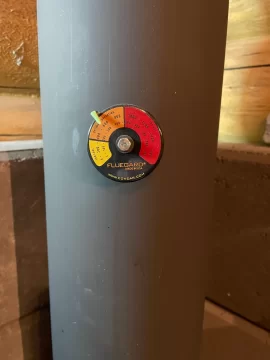
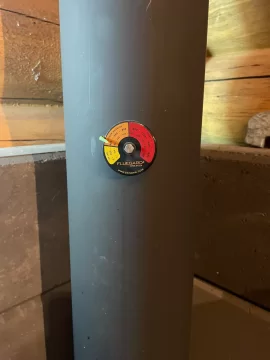
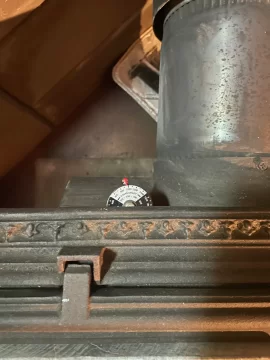
Flue internal was never over 300. As you can see, the Fluegard meter is just above where the chimney goes vertical, at the end of a 6" long tee snout. You can barely see it, but there's another surface meter on top of the tee snout, which ends up reading about the same as the internal Fluegard, probably due to its lying on top of the horizontal tee snout, where the temp is hottest.
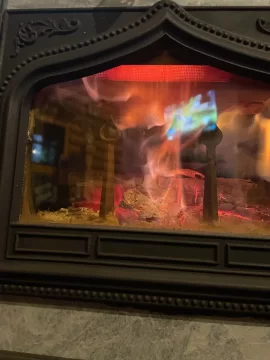
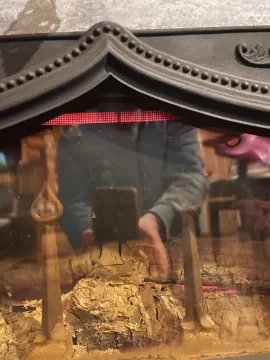
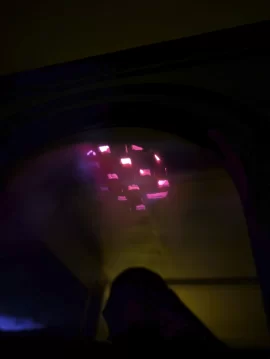
When the cat is about 1400, I can no longer see the individual cells of the steel cat (it isn't yellow, as a couple of spots in the image would appear, but it is getting fairly bright orange.) Stovetop is about 300 at this point, but will eventually go to about 450.
I then cut the air almost completely and the cat settled in at about 1250.
I have the Auber alarm set at 1450 so if I doze off, no worry about the cat going high. The video below was from two nights ago.
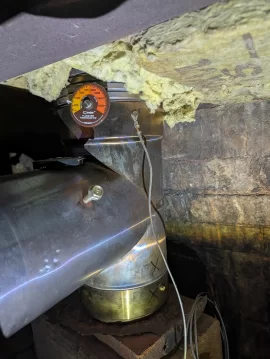
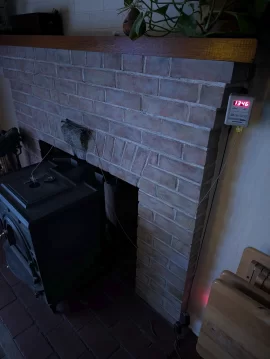
Flue internal was never over 300. As you can see, the Fluegard meter is just above where the chimney goes vertical, at the end of a 6" long tee snout. You can barely see it, but there's another surface meter on top of the tee snout, which ends up reading about the same as the internal Fluegard, probably due to its lying on top of the horizontal tee snout, where the temp is hottest.
When the cat is about 1400, I can no longer see the individual cells of the steel cat (it isn't yellow, as a couple of spots in the image would appear, but it is getting fairly bright orange.) Stovetop is about 300 at this point, but will eventually go to about 450.
I then cut the air almost completely and the cat settled in at about 1250.
I have the Auber alarm set at 1450 so if I doze off, no worry about the cat going high. The video below was from two nights ago.
Last edited:
That's what I like about the digital setup; You know exactly when you can close the bypass, instead of relying on other slower meters, and to some extent ending up guessing about when to close it. I don't want to run any longer than I need to with the air open, burning up my wood just to make certain the cat will take off. But it might burn a little more creo outta the box, running hotter for longer every time; That's the BK way. But with my stoves, I don't need to worry about creo eating a hole through the thin box.😏I have no idea about the Progress, what the cat will do with a black box. I’m hoping it’s fine, can’t wait to find out. Last season it went black box sometimes for sure. Nothing has warped yet.
But it’s just crazy to me that nobody knows that I can find, nobody I can find has monitored the cat, and Woodstock won’t say anything about it....if I knew the temperature at the cat it would be a no brainer at start up to know when the cat lights off instead of wondering..
I find that I can close the bypass below 500, and the flame in the box will quickly take it above 500 in less than half a minute at which point I cut the air to cruise level.
Yep, "crazy" that with all the reports of warping cats and internal parts, that more people aren't running an Auber setup in the PH.
I wonder if you'll find that the cat is indeed going high, although that may depend in part on your particular stove/chimney setup.
If it was going high, and you couldn't get the cat temp down even if you cut the air all the way, a next step might be to modify the air intake so you could cut it lower. Then you'd also have to make sure that the cat didn't later crash, causing your stove to burn dirty. Maybe that's why the folks at Woodstock don't seem to want to talk about it...because that would be a violation of federal law, not to mention that it would require a level of stove operation nerd-dom to which most stove owners do not rise. 🤔😆
Last edited:
According to my still-evolving understanding of the Progress Hybrid, to cool the cat I might want to *increase* the air. That brings the action down to the firebox, more smoke burned there and less for the cat to do.
But it’s also tricky. More air will sometimes bring more flame down to the logs and less secondaries. It’s a bit Golidlocks to get the secondaries really doing a lot of the work. It seems to depend on the wood a lot. When I first got the stove I was going through some super dry cherry, which made really nice secondaries easily. It was also super cold then, so I had a hot stove and a lot of coals all the time. Got into the dry previous year cut ash, which did almost as well. Then with the winter so cold I got into some early summer cut ash that was a bit over 20% and it was different again.
But it’s also tricky. More air will sometimes bring more flame down to the logs and less secondaries. It’s a bit Golidlocks to get the secondaries really doing a lot of the work. It seems to depend on the wood a lot. When I first got the stove I was going through some super dry cherry, which made really nice secondaries easily. It was also super cold then, so I had a hot stove and a lot of coals all the time. Got into the dry previous year cut ash, which did almost as well. Then with the winter so cold I got into some early summer cut ash that was a bit over 20% and it was different again.
Yeah the hybrid PH will act differently than a true cat stove. I think you’re right about cooling the cat with more air and letting the secondaries take over the bulk of the burn. Probably most efficient with a little flame in the box and the cat cleaning up. The EPA tests would show this.
bsw
Member
Not sure if I missed this being linked already, but if not I'll link it again below with a couple noteworthy pages since we're already nerding out and it's been mentioned a few times.
Progress Test Data
Pages 251-254 - Pretty comprehensive run data showing cat temps bumping up to ~1300 occasionally, but in general staying pretty significantly below.
Pages 316-320 - Photos of the test.
Page 357 - Diagram with photos of the cat probe placement.
Progress Test Data
Pages 251-254 - Pretty comprehensive run data showing cat temps bumping up to ~1300 occasionally, but in general staying pretty significantly below.
Pages 316-320 - Photos of the test.
Page 357 - Diagram with photos of the cat probe placement.
Interestingly, I just searched for and found that a little while ago. Good to know about the cooler cat. But this test is probably pretty constrained, with their crib wood and all. Might be different to put 30 pounds of hardwood onto hot coals for an overnight, which is when I get worried. Still haven’t fired up the stove since I got the Auber stuff, but that is coming up fast!
Interestingly, for the minimal burn test they are shutting the air all the way closed after getting the fire established. That’s one thing I’ve never been quite sure is OK. The manual specifies shutting it to something like the first large mark on the dial, which is definitely not all the way closed.
They are required now to test at fully closed and open. So they had to tweak their air settings a bit to pass. The older stoves prior to this new testing probably closed down more. I tried searching for the old cordwood tests with no luck.Interestingly, for the minimal burn test they are shutting the air all the way closed after getting the fire established. That’s one thing I’ve never been quite sure is OK. The manual specifies shutting it to something like the first large mark on the dial, which is definitely not all the way closed.
I’m just thinking it’s good that testing fully closed the cat isn’t going to the moon. That’s black box burning, mostly. Sometimes I can get some flame and secondaries with the air closed, but usually I need it open just a little to get consistent flame. So the cat has to do all the work of smoke burning, and it seems it can handle it.
Is there any way you can see if the cat is glowing in the PH? On the Dutchwest, Fireview, Keystone I can see the cat through the window. On the Buck 91, I could see if the cat was glowing by looking through the small gap around where the bypass rod went through the front wall above the door. I couldn't see it much but if I got my eye at just the right angle l could definitely see a glow, and I could correlate the brightness with the temps I was seeing on the 6" analog Condar probe.Good to know about the cooler cat. But this test is probably pretty constrained, with their crib wood and all. Might be different to put 30 pounds of hardwood onto hot coals for an overnight, which is when I get worried. Still haven’t fired up the stove since I got the Auber stuff, but that is coming up fast!
If you can't see the PH cat through the glass, can you take the bolt out of the probe hole, and see it that way by looking through at different angles? Might be a thing to try before you install the Auber and block that hole..
No way to see the cat. And I’m not even sure if there is any good view from the bolt hole. The way the probe goes in through the hole it goes up over the cat housing — might have a view of the back of the cat I supppose.
Anyway, have the auber probe installed, waiting for the first fire with it. Probably tonight. Cold rain and snow on the way here.
Anyway, have the auber probe installed, waiting for the first fire with it. Probably tonight. Cold rain and snow on the way here.
A few times on the Buck 91, with a bright glow, the 6" Condar probe would push 1500*.Buck 91, I could see if the cat was glowing by looking through the small gap around where the bypass rod went through the front wall above the door. I couldn't see it much but if I got my eye at just the right angle l could definitely see a glow, and I could correlate the brightness with the temps I was seeing on the 6" analog Condar probe.
Somewhere, possibly on here but more likely on the other site, there's a lot of data I published when I first put instrumentation on my Woodstock Ideal Steel. I had thermocouples in the top of the firebox, directly above the cat, on the stove top, and in the flue 12" above the coupler to the stove. The flue temp and the cat temp were the most useful, honestly. On a typical light up, I'd leave everything open until the flue temp showed ~730-740F, then throw the cat in. That would instantly cut the flue temps down to 500F or just below. If the cat temps climbed within the first 15 seconds, everything was going to work out right. If the cat temp dropped or stagnated, I'd thrown the cat in too early and the burn was going to smoulder. Assuming it took off, then I'd let the flue temp recover to 600F (took ~5minutes) before starting to shut the throttle down, aiming for a cruising flue temp between 500-550F.
Very early in the burn, the cat probe would read as high as 1200F due to direct flame impingement on the sensor. As the fire settled down into secondary mode, the cat temp would run around 600F. Once the burn transitioned over into black-box/cat-only mode, cat temps would rise to >800F while the flue temps would stay around 500F.
After about 5 years, the stove started doing something that worried the hell out of me but I never figured it out before we sold the house. The burn would start perfectly normal, go through the secondary phase perfectly normal, but would then transition to black-box and go China Syndrome. Cat temps would climb well above 1200F, sometimes 1400F, while the flue temp would climb over 1000F. Nothing I could do would slow it down at that point. Dark box, everything closed, no levers left to pull, just the stove running out of control. I was never able to tell what made the difference between a nice controlled burn and a near-miss house fire.
but would then transition to black-box and go China Syndrome. Cat temps would climb well above 1200F
This is why I want to monitor it. Though also, frankly, I am probably very prone to close the bypass too early. I’m not sure if I’ll ever learn, but instrumentation might help.
Also, I think with these hybrid stoves, the thing to do when the cat is going China Syndrome would be to open the air and let flames in the firebox burn smoke instead of the cat.
When the Buck 91 cat pushed toward 1500, I sometimes had to open the bypass to cool off the cat. But in that situation, you've got to somehow get less wood gassing in order to be able to close the bypass and have the cat temp stay under control. About the only way to do that is to have the ability to cut the air further. If you get flame going in order to eat some of the smoke, you're getting more wood gassing and you don't have the option to get a black box, bypass closed, and low cat temp. If you want to conserve wood, or decrease heat output, you're SOL.Cat temps would climb well above 1200F, sometimes 1400F, while the flue temp would climb over 1000F. Nothing I could do would slow it down at that point. Dark box, everything closed, no levers left to pull, just the stove running out of control.
Last edited:
Similar threads
- Replies
- 8
- Views
- 624


- Replies
- 12
- Views
- 2K
