
Jotul F45 or F500

  • Active since 1995, Hearth.com is THE place on the internet for free information and advice about wood stoves, pellet stoves and other energy saving equipment.

    We strive to provide opinions, articles, discussions and history related to Hearth Products and in a more general sense, energy issues.

    We promote the EFFICIENT, RESPONSIBLE, CLEAN and SAFE use of all fuels, whether renewable or fossil.
The sales person is wrong, my F45 had a gap between the steel box and cast iron jacket.

I wonder if he’s confusing the F45 and the F445?
 
I beg to differ with the sales person. The cast iron panels do have a gap between the steel inner body and outer panel. And, IIRC, there is a vent slot at the top of the side panels. @Todd, your thoughts?

Yes, the PE blower is pretty quiet

Green, I’m just confused what to go with.

Any real differences between the F500 and the T5/F45

Is there going to be a huge upgrade with any of these stoves and installing cold air intake/insulated liner and blower compared to the Sheffield with no liner, no blower, no cold air intake?

Will a f500, f45, T5 just be a whole other level?
 
Last edited:
Any real differences between the F500 and the T5/F45
I'm sorry, but this has been asked and answered repeatedly. They are differently constructed stoves, one radiant and the others convective, like the Sheffield but with larger capacity.
 
Ah ok I wonder what changes they made then?

The F500 is a strong radiant heat type stove so in my opinion it’s better suited for a wide open space. In a smaller space it may cook you out.

The F45 has a cast iron jacket around a steel firebox that blocks most of that radiant heat and it creates some convection through that space inbetween. This makes the radiant heat less intense and feels a little softer so it shouldn’t cook you out of a smaller space.

I’m not a big fan on blowers, they are mostly noisy and costly. I prefer a ceiling fan or a small cheap fan on the floor blowing the cooler denser air towards the stove.
But isn’t a blower just a form of convection?
If I got the F500 with a blower wouldn’t that throw that heat outwards?

You speak of convection and radiance but isn’t a radiant stove with a blower now acting in convection?

If the Sheffield heats my living room to 70 and dining/kitchen to 55 what should I expect with a f500 or f45 with blower also with outside air connection, double walled insulated liner, steel block off plate and blower do?
Is it going to be a different world?

I’m a disabled vet on a fixed income and $4500 is a really big purchase for me. That’s why I’m asking cause I have little stove experience.
All stoves are both radiant and convective to some degree. It won’t make a huge difference from your other stove if don’t think.

If you’re concerned about the cost I think I would keep the Sheffield and work on improving the install with a block off plate and insulated liner. Also look into insulation improvements throughout your home. You can always purchase a larger stove later on.
 
  • Like
Reactions: stoveliker
All stoves are both radiant and convective to some degree. It won’t make a huge difference from your other stove if don’t think.

If you’re concerned about the cost I think I would keep the Sheffield and work on improving the install with a block off plate and insulated liner. Also look into insulation improvements throughout your home. You can always purchase a larger stove later on.
you kind of avoided my questions, thanks. Insulation for my house is a $15,000 job. It’s a 1870 farmhouse with plaster walls. It’s a crazy job. $5000 vs 15,000. They have to drill 5” holes every 12-14” to blow in the rock wool cause if they just did it from the top the rock wool would catch against the lathe nails and exterior sheathing nails. Then the expense of repairing hundreds of plaster holes.

Alternative is removing ALL plaster interior that face exterior walls and insulate and put up drywall.
If you knew anything about construction you’d know how giant that bill would be. You can only use rockwool as fiberglass or foam will mold quickly. I’ve done a very deep dive into all this when I looked at buying the house to weigh as pros and cons. I did many years of construction myself and know the amount of work included.

Can you please tell me your thoughts on how much difference the Sheffield bs f500 or f45 ?

The Sheffield has to go, I had to remove the legs and sit it on bricks to be low enough to have the top vent go into the flue which is not a good long term
Plan.

Where the block off plate should be I stiffed rockwool 12” thick around the flue pipe so no heat is exiting so other than the physical barrier a metal plate brings the heat energy can’t be escaping any different.

The Sheffield was a quick fix that’s all.

On a 20f day the living room is 70, dining and kitchen are around 50. Upstairs 50s.

Would a f500/f45/T5 with outside air connection, insulated liner, blower get these other rooms 10 degrees warmer?

the Sheffield has a 90 degree turn immediately attached to the top vent to clear the firebox lentil and to a second 90 degree to go upwards. It’s janky and not a solution I want any longer.

I can’t move it back any more cause the entire stove would be inside the fireplace firebox trapping more heat.
A rear vented stove brings the stove outwards to better radiate and operate. Only 7” of the stove is past the face of the firebox. The rear vented stoves would be 18” minimum past the face. Plus the Sheffield can’t only take 15-16” pieces and 1.3cf firebox is small.
 

Attachments

  • [Hearth.com] Jotul F45 or F500
    IMG_0710.webp
    169.5 KB · Views: 11
you kind of avoided my questions, thanks. Insulation for my house is a $15,000 job. It’s a 1870 farmhouse with plaster walls. It’s a crazy job. $5000 vs 15,000. They have to drill 5” holes every 12-14” to blow in the rock wool cause if they just did it from the top the rock wool would catch against the lathe nails and exterior sheathing nails. Then the expense of repairing hundreds of plaster holes.

Alternative is removing ALL plaster interior that face exterior walls and insulate and put up drywall.
If you knew anything about construction you’d know how giant that bill would be. You can only use rockwool as fiberglass or foam will mold quickly. I’ve done a very deep dive into all this when I looked at buying the house to weigh as pros and cons. I did many years of construction myself and know the amount of work included.

Can you please tell me your thoughts on how much difference the Sheffield bs f500 or f45 ?

The Sheffield has to go, I had to remove the legs and sit it on bricks to be low enough to have the top vent go into the flue which is not a good long term
Plan.

Where the block off plate should be I stiffed rockwool 12” thick around the flue pipe so no heat is exiting so other than the physical barrier a metal plate brings the heat energy can’t be escaping any different.

The Sheffield was a quick fix that’s all.

On a 20f day the living room is 70, dining and kitchen are around 50. Upstairs 50s.

Would a f500/f45/T5 with outside air connection, insulated liner, blower get these other rooms 10 degrees warmer?

the Sheffield has a 90 degree turn immediately attached to the top vent to clear the firebox lentil and to a second 90 degree to go upwards. It’s janky and not a solution I want any longer.

I can’t move it back any more cause the entire stove would be inside the fireplace firebox trapping more heat.
A rear vented stove brings the stove outwards to better radiate and operate. Only 7” of the stove is past the face of the firebox. The rear vented stoves would be 18” minimum past the face. Plus the Sheffield can’t only take 15-16” pieces and 1.3cf firebox is small.
Sorry I didn’t mean a total house insulation redo, was just thinking of caulking leaks and maybe adding some insulation to the attic.

I’m not familiar with your stove but if it has that small 1.3 cu ft firebox yes the F45 or F500 will make a difference, how much I’m not sure. It will be warmer because they hold much more wood and BTU’s.

I would go with the F45 and a blower to help push any trapped heat behind the stove in your fireplace. It’ll be easier to load it straight in N/S. Not sure if you would be able to use the side loading door of the F500 unless you bring the stove out and that may not meet clearance requirements in front?

I would also try the F45 without the outside air kit first to see how it works before spending extra money. An Oak may not make any difference in a leaky old farmhouse imo.
No need to be sorry in any way.

Attic all insulated in rafters and floor boards/2nd story ceiling.

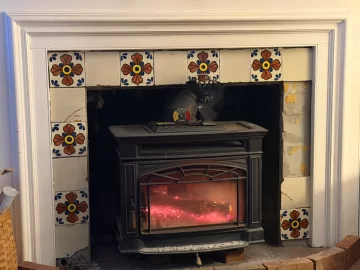
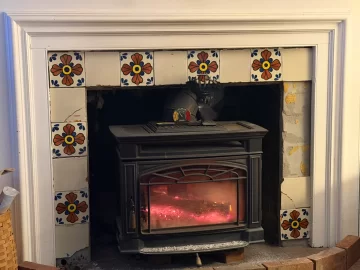
Yes the F500 fits fine using the loading side door I measured. I’m extending the hearth by 6” and replacing the red tiles to 3/4” granite or blue stone pieces probably 18x20” pieces so the entire hearth will be about 6 pieces. It’s a little cleaner look and less bust than the tiles.

The folk era tiles surrounding the firebox will be removed and 12-14” of the wood trim removed and replaced with red brick. And at the top of the brick will be a 1-1.5” metal lip to further push heat from collecting under the mantle. If heat continues to collect I’ll either line the mantle bottom with a non combustible or replace entirely with a marble or similar piece.

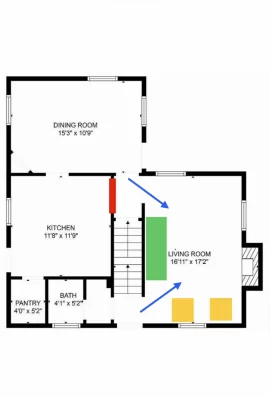
Couch in green, chairs in yellow. You can feel cold air rushing by to feed the fire (blue arrows). I just feel that the outside air intake will decrease the negative pressure from the stove sucking in cold air from outside.

I was advised to hang toilet paper lengths of 18” at the entrance and at knee level of those two areas the air is passing by and the bottom pieces waved but the top ones denoting hot air barley moved so im getting cold air in but not pushing warm air out
 

Attachments

  • [Hearth.com] Jotul F45 or F500
    IMG_0710.webp
    169.5 KB · Views: 10
  • [Hearth.com] Jotul F45 or F500
    IMG_0741.webp
    24 KB · Views: 9
The replacement stove will have a bigger firebox, or in other words, a larger fuel tank. The F500 will have approx. 46% greater fuel capacity. The F45 will have approximately 77% greater capacity. How hot the room will be on a cold day is up to how full the stove is loaded and you, the person running the stove. The F500, like the Sheffield, will not be able to load to full capacity due to E/W loading. That is not an issue with the F45 loaded N/S. Run properly, the main benefit from upsizing from the 1.3 cu ft Sheffield will be longer time between refueling.

A smaller room does not benefit from a radiant stove, especially in a exterior fireplace. A good portion of the heat coming off the sides and back will be disipated to the outdoors through the brick of the exterior fireplace, aka wasted heat. If you know someone with an IR camera, this will be self-evident. The heat loss will be less of an issue with a convective design stove like the T5 or F45 where most of the heat is from the front and top of the stove.
 
Last edited:
Not sure how much the OAK will help. It sounds good in theory but you will still see that air movement along the floor due to natural convection. You can always add it later.

I still like the F45 for your situation but I also like the looks of the F500 better. Either stove should do better than what you have now.

You would need 20-24” splits to fill the F500 to capacity. The F45 likes 16-18”.
Air movement is fine if it’s mostly air from inside the house circulation from convection.
Big difference I think drawing inn20f air compared to 40/50 air from circulating house air.
And isn’t circulating air better for heating other parts of the house?

The outside air intake is $35 and I already have the stainless flexible ducting so $35 isn’t hurting me.

Yes the F500 is a handsome stove for sure. Today it was 63F at 7am and high of 67F where I’m at.

I was a navigation officer in the Navy so I had become a mini meteorologist and this super El Niño is working as predicted, supposed to me a mild winter in mid Atlantic and hopefully it keeps up which allows me more time to decide.
My shop said they expect their F45’s to arrive before end of year.
 
Not sure how much the OAK will help. It sounds good in theory but you will still see that air movement along the floor due to natural convection. You can always add it later.

I still like the F45 for your situation but I also like the looks of the F500 better. Either stove should do better than what you have now.

You would need 20-24” splits to fill the F500 to capacity. The F45 likes 16-18”.
You responded with a F45 design schematic but I don’t see it attached anymore. Could you attach it again please?
 
You responded with a F45 design schematic but I don’t see it attached anymore. Could you attach it again please?
That wasn’t me. I haven’t seen the new F45 design, I’ll look for it though
 
The sales person is wrong, my F45 had a gap between the steel box and cast iron jacket.

I wonder if he’s confusing the F45 and the F445?
Salesman said I can switch my deposit to F45.

Before I confirm doing so I had two last questions

F45 being steel and cast iron. Does that make its lifespan shorter compared to a fully cast iron unit like the f500?

What year was the F45 first made, I can’t find that at all

Thanks so much for your help and info, as well as Green in this decision process.
Not necessarily, both cast iron and steel have their limits. I actually think the steel firebox can handle those high firebox temps better. Just follow the manufacturer’s guidelines and you should be fine. Stove pipe and stove top thermometers are a good tool for proper burning.

Not sure when the F45 first came out? I bought my V2 back in 2020. I believe the F50 with the top load was first then that evolved into the F55 then the F45 and F35.

Keep us posted on your new install, I’d be interested in what the new F45 changes are.
 
The F45 came out around 2012 or 2013 IIRC. The F45v3 will be an updated variation.

How long a stove lasts depends on how it is run and maintained. A well designed cast iron or steel stove can last decades, though the cast iron stove will likely need a rebuild at 15-20 yrs. to reseal the joints and and redo gaskets.
 
  • Like
Reactions: 1870farmhouse
Google AI says F45 first came out in 2014. I bought mine in 2017.
 
Just checked, my manual is dated March 2013. If more info is desired, search on F45 title only for the first postings.
 
The F45 came out around 2012 or 2013 IIRC. The F45v3 will be an updated variation.

How long a stove lasts depends on how it is run and maintained. A well designed cast iron or steel stove can last decades, though the cast iron stove will likely need a rebuild at 15-20 yrs. to reseal the joints and and redo gaskets.
Thanks green for all your help. I know I annoyed you with asking similar questions but I have TBI traumatic brain injury from Iraq and slightly affects my short term memory or things very similar. So not asking for pity but thought you should know.

I just emailed the salesman approving the switch. He replied saying the heat shield I’d need for a blower is already part of the F45? Didn’t notice that in my research but thought I mention it to confirm

Excited for the N-S loading and longer burns. Looks like the msrp should be around 3500 so after selling my Sheffield for around 700-800 which seems fair I’ll only owe 2700 plus blower and short leg kit.
 
  • Like
Reactions: stoveliker and Todd
It's a big decision. The F45 has been a popular stove and a good performer. We'll be looking forward to hearing how it works out.

And thanks for your service to the country!
 
  • Like
Reactions: stoveliker and Todd