
What Is In Your Stove Right Now?

  • Active since 1995, Hearth.com is THE place on the internet for free information and advice about wood stoves, pellet stoves and other energy saving equipment.

    We strive to provide opinions, articles, discussions and history related to Hearth Products and in a more general sense, energy issues.

    We promote the EFFICIENT, RESPONSIBLE, CLEAN and SAFE use of all fuels, whether renewable or fossil.
@Dieselhead You got two BK40s now?? I do a top down every cold start. Wouldn’t do it any other way honestly

sig line says one King one Princess. Still, that's pretty awesome. One guy on this forum using more wood than me, other than those OWB nuts! ;lol
Correcto, 1+1. I guess doing a top down never appealed to me, because you know, fire burns upward. So if you start it at the top the kindling will burn out and the logs won’t catch. Maybe I just have to put physics aside as I see it does work in each one of your cold start pics with the pinecones 🤣

@Ashful i do not believe I will touch your wood or BTU consumption by far. These stoves loaf along (black box mode) where yours seem to full on inferno themselves through the season. That is my hope anyways 😎
 
Correcto, 1+1. I guess doing a top down never appealed to me, because you know, fire burns upward. So if you start it at the top the kindling will burn out and the logs won’t catch. Maybe I just have to put physics aside as I see it does work in each one of your cold start pics with the pinecones 🤣
Top-down seems pointless to me, in a cat stove. We want to get the whole load engulfed as quickly as possible, not artifically control and extend the burn. Our stoves do that for us! ;lol

@Ashful i do not believe I will touch your wood or BTU consumption by far. These stoves loaf along (black box mode) where yours seem to full on inferno themselves through the season. That is my hope anyways 😎
Misery loves company. I was out splitting wood again today, as I was last weekend, the weekend before that, the weekend before that...

One of my stoves always runs black box mode, but the other is often throttled up higher, sometimes full loads WOT. But this time of year, it's just half loads for the overnight, usually run black.
 
I do top down because I think the cat gets warmer quicker that way. So I close the bypass sooner (and run high for a bit more after that to get the load going well before I dial down).
 
Summit has some oak, ash, and a few red maple / birch rounds.

The oak was a little damp from the rain, so she took a while to light off.

[Hearth.com] What Is In Your Stove Right Now?

[Hearth.com] What Is In Your Stove Right Now?
 
I do top down because I think the cat gets warmer quicker that way. So I close the bypass sooner (and run high for a bit more after that to get the load going well before I dial down).
See, I load kindling right inside the door and the fire runs up the face of the logs dancing around the face of the cat, where if I do a top down the fire goes up the flue after bouncing off the bypass chamber a little bit, behind the cat. That’s why I always did a bottom up burn. I figured it gets the cat hotter, quicker.

Anyhow, basement at 70, started at 62, still a half load of wood left in the box, stat at 4:00 position overnight. STT of 325. This stove burns much different than my King’s thermostat setting wise. Flue is the biggest contributor to that is what I’m thinking.
 
How/Why Top Down works:

A fire radiates thermal energy in a 360-degree pattern primarily through thermal radiation (electromagnetic infrared waves), which travels outward in all directions from the source.

Key Reasons Top-Down Fires Excel
    • Instant Flue Priming and Draft: Lighting the fire at the top puts the initial heat source right near the flue outlet or chimney neck. This warms the cold air inside the chimney liner immediately, establishing a strong upward vacuum (draft) before heavy smoke can build up. [1, 2, 3]
    • Cleaner Combustion and Less Smoke: In a conventional fire, cold logs smother the flame or release unburnt gases and hydrocarbons that escape as smoke and create creosote. In a top-down burn, any smoke or gases released from the lower wood must travel up through the hot flames at the top, which reburns and incinerates those particles cleanly. [1, 2, 3, 4, 5]
    • Gentle Preheating of Fuel: As the kindling and small pieces burn down, glowing embers drop naturally onto the larger logs beneath them. This gradually dries and preheats the heavy hardwood logs so they ignite smoothly without choking or smoking. [1]
    • Unobstructed Oxygen Flow: Stacking larger logs flat on the bottom with cross-hatched kindling on top creates a "pallet-like" structure with ample air gaps. Oxygen moves freely through the top layers without being choked by collapsing heavy logs. [1, 2]
    • Low Maintenance ("Set It and Forget It"): Because the fuel feeds downward on its own over several hours, you rarely need to poke, stir, or rush back to add wood during the critical startup phase.
Agreed on most of these points, except #3. But I'd still argue these advantages aren't as applicable to most cat stove installations:

1. Flue priming: Excepting the very rare scenario of wanting to light a fire when it's warm outside, my flue already works fine before I light any fire, no need to "prime" it. That said, I'm aware there are badly-designed setups that downdraft and require priming, so this may be an advantage for a select few operators.

2. Cleaner combustion and less smoke is achieved when you close the bypass damper. You will always get there quicker lighting bottom-up than top down, since you really can't close bypass until entire wood load is engulfed and charred.

3. Gentle preheating: What?!? Who cares about being "gentle" with the thing you're about to turn to ash. Stupid.

4. Unobstructed oxygen flow: This is the one that comes closest to being a legit advantage in a cat stove. Still loses out to issue 2, tho.

5. Set it and forget it: Sounds like a problem for non-cat burners, from everything I read here. It's certainly no issue for anyone running a BK stove, ours are already built to "set and forget".
 
  • Like
Reactions: ctreitzell
@Dieselhead You got two BK40s now?? I do a top down every cold start. Wouldn’t do it any other way honestly
Yep, top down is my saviour
It won’t prime my chimney install, tho!

I build the fire puzzle;
pre-heat with a hair dryer for 6-7min;
Propane torch for 2 min
And it’s a guaranteed start as long as my wood is dry enough

I never use paper or firelighters
 
Last edited:
  • Like
Reactions: Dieselhead
2. Cleaner combustion and less smoke is achieved when you close the bypass damper. You will always get there quicker lighting bottom-up than top down, since you really can't close bypass until entire wood load is engulfed and charred.
That's not how I operate my stove.
In my understanding the charring needs to happen before you dial down, not necessarily before the bypass is closed.
So I close the bypass the moment the cat is up to temp, leave the air wide open until charring is sufficient, and then dial down.
On a reload without relighting with the cat still in the active zone, that means I load, close the door (as the wood catches already during loading, most of the time), leave the bypass open for a minute or 2 max to exhaust the colder room air in the box, and then close the bypass. Then dial down after charring is done.

@Dieselhead
When I start, I have my splitter trash right at the front on top. I see about half the flame going to the bypass, and half into the cat.
Of course if one put kindling etc. all over the top, including farther back, then most of that won't have its flame go to the cat - yet the radiative load is significant, and will heat up the cat as well.

BUT, this all belongs in a BK performance thread, not here. (Which, btw, would be akin to the VC performance thread- but we were told by the mods here that the BK thread was not useful, while for VC it apparently is okay to have a general BK discussion/performance thread.)
 
Agreed on most of these points, except #3. But I'd still argue these advantages aren't as applicable to most cat stove installations:

1. Flue priming: Excepting the very rare scenario of wanting to light a fire when it's warm outside, my flue already works fine before I light any fire, no need to "prime" it. That said, I'm aware there are badly-designed setups that downdraft and require priming, so this may be an advantage for a select few operators.

2. Cleaner combustion and less smoke is achieved when you close the bypass damper. You will always get there quicker lighting bottom-up than top down, since you really can't close bypass until entire wood load is engulfed and charred.

3. Gentle preheating: What?!? Who cares about being "gentle" with the thing you're about to turn to ash. Stupid.

4. Unobstructed oxygen flow: This is the one that comes closest to being a legit advantage in a cat stove. Still loses out to issue 2, tho.

5. Set it and forget it: Sounds like a problem for non-cat burners, from everything I read here. It's certainly no issue for anyone running a BK stove, ours are already built to "set and forget".
Fair point with a cat stove i guess, i've never had a cat stove.
But for tube stoves, All the above are true at least for my f400 and jotul 118 clone.

1. Flue (actually more importantly the top Baffle) warms faster and with much less smoke than than a bottom up in the jotul 118 clone with minor cold flue downdraft issue.
2. Much cleaner combustion at start up in both my stoves.........No bypass in my stoves so that part Not applicable for my use.
3. Less smoke up chimney by less smoldering of big bottom logs and that smoke getting reburnt by flames above and faster secondary light off.
4. Greater airflow helps both top down and bottom up at light off and burn.
5. Set it and forget it is a big plus for Non cat. I light the top down, close the door almost immediately and don't open that door for a few hours later to reload on coals.
 
Correcto, 1+1. I guess doing a top down never appealed to me, because you know, fire burns upward. So if you start it at the top the kindling will burn out and the logs won’t catch.
Well, then, you haven’t built your puzzle to burn !

My main reason for top-down is the amount of smoke…but I do cheat with a propane torch
 
Also i can light a top down with much less kindling/firestarters/small splits than a bottom up.

I could never get a good bottom up fire going that includes numerous large splits with the small amount of kindling and splits i use in top down setups.

And that includes the N/S loading cigar burn in the jotul 118 clone.
 
  • Like
Reactions: ctreitzell
Has science proven that side or bottom burns with lots of fire starter/kindling are less polluting than top-down burns? The provers? Austrian masonry heaters builders. They had been taught there whole lives that top-down starting was the best method. So to prove it, they measured the pollutants for top-down starting and bottom-up burning. Of course they figured, top-down would be the victor. "Hans, read me that data again. I can't believe this is true. The bottom-up fire starting is less polluting? But we were taught that top-down is the best." Why, why, why, how can it be? "Hans, pass me the schnitzel and Heineken."

Because top-down is too cold a flame to burn the rising gases. And this flame is not hot enough to engage the secondary burning hardware in the stove or heat up the mass in a masonry heater. "Well, I can't see any pollutants." With such a little cold flame that is normal. It doesn't mean they aren't there. "And when I do a bottom-up burn I see smoke gushing out the chimney. So, top-down must be cleaner. Right?" With the bottom-up you see smoke initially but then it clears. But with the top-down you don't see much smoke. That fire burns downward and it takes a long time getting going - a 'cold flame'. Cold flames are polluters. This cold flame releases gases but does nothing with them.

"Is this some sort of optical illusion. The dirty smoky method is cleaner than the no visible smoke method?" Yes, because in the dirty smoky bottom-up method the smoke doesn't last very long. In the top-down method the release of pollutants lasts a long time. These builders were surprised about the results they had found - it went against what they had been taught.
 
Last edited:
  • Haha
Reactions: Dieselhead
That's not how I operate my stove.
In my understanding the charring needs to happen before you dial down, not necessarily before the bypass is closed.
So I close the bypass the moment the cat is up to temp, leave the air wide open until charring is sufficient, and then dial down.
Interesting. And I know you have the experience to really know the difference.

In the case of my stoves, always placing a SuperCedar at the bottom of a load, the load is always charred long before the cat is up to temp. So I'm doing the opposite, usually closing the bypass long before the cat probe indicates active, but knowing it'll take off just fine anyway.

I guess this just goes to show how different every installation is?

The surprising thing is that I have one stove running on just 15 feet of pipe, with the lower half of that being uninsulated single wall, and the other running on a full 30 feet of double-insulated pipe into blanket wrapped liner, and they both fully char their loads before the cat probe needle reads active. I'm usually closing the bypass when it's just 1/2 to 2/3 thru the Inactive region, on a cold start.

I'd have thought my two stoves would sort of cover the two extremes of operation, but apparently not!
 
  • Like
Reactions: stoveliker
Has science proven that side or bottom burns with lots of fire starter/kindling are less polluting than top-down burns? The provers? Austrian masonry heaters builders. They had been taught there whole lives that top-down starting was the best method. So to prove it, they measured the pollutants for top-down starting and bottom-up burning. Of course they figured, top-down would be the victor. "Hans, read me that data again. I can't believe this is true. The bottom-up fire starting is less polluting? But we were taught that top-down is the best." Why, why, why, how can it be? "Hans, pass me the schnitzel and Heineken."

Because top-down is too cold a flame to burn the rising gases. And this flame is not hot enough to engage the secondary burning hardware in the stove or heat up the mass in a masonry heater. "Well, I can't see any pollutants." With such a little cold flame that is normal. It doesn't mean they aren't there. "And when I do a bottom-up burn I see smoke gushing out the chimney. So, top-down must be cleaner. Right?" With the bottom-up you see smoke initially but then it clears. But with the top-down you don't see much smoke. That fire burns downward and it takes a long time getting going - a 'cold flame'. Cold flames are polluters. This cold flame releases gases but does nothing with them.

"Is this some sort of optical illusion. The dirty smoky method is cleaner than the no visible smoke method?" Yes, because in the dirty smoky bottom-up method the smoke doesn't last very long. In the top-down method the release of pollutants lasts a long time. These builders were surprised about the results they had found - it went against what they had been taught.
I've read studies like this before, but your example is with masonry stoves. I have no idea the physics / airflow etc. of those.

I can say i've had my f400 secondaries light off in less than 5 minutes with top down. At that point the smoke is being burnt. There is no way a bottom up in this stove, with the same amount and sizes of wood and starter, will light off the secondary burners anywhere near as quickly........ More like 10-15 minutes, at least, with a perfect set up with lots of kindling/small splits and only 1 or 2 larger splits.
With the bottom up smoky starts, all the heavy smoke does go right up unburnt.
 
Lol, this all sounds like a splitter debate: horizontal or vertical ;lol
 
  • Haha
Reactions: stoveliker
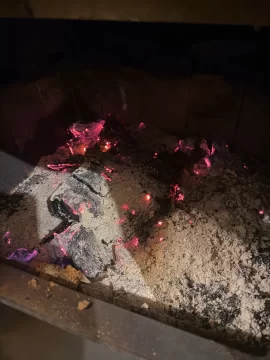
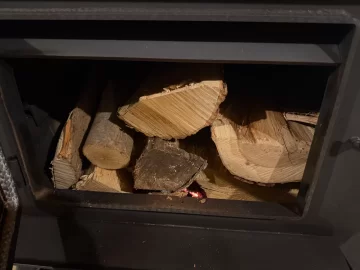
Last nights left over coals and tonight’s load. Hickory, spruce and maple. The little princess is doing good!
 

Attachments

  • [Hearth.com] What Is In Your Stove Right Now?
    IMG_9769.webp
    224.1 KB · Views: 13
  • [Hearth.com] What Is In Your Stove Right Now?
    IMG_9770.webp
    93 KB · Views: 12
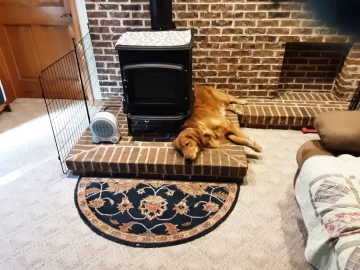
No burning yet it's been too warm. 1-1/2 year old Rossi ain't a fan of woodstove burning and warmth and hopes we never burn. He naps on the cool bricks of the hearth. He prefers the bricks to a comfortable sofa. He will be evicted from the hearth by the weekend as it looks like a cool period coming.
[Hearth.com] What Is In Your Stove Right Now?
 
  • Like
Reactions: Dieselhead