

I really dont understand the point of going off grid then relying on people for your fuel your maintenance etc etc etc. And 3.6 tons would absolutely not be enough for the year to heat a log cabin that size with those temps. I doubt 6 cords of probably soft wood will be eitherFrom October 1st to May 30 is around 241 days.
You'll need at least minimum around 3.6 tons ( 7,239lb pounds) of anthracite coal if used as your primary fuel source daily for those 241 days.
Anthracite coal bought in bulk is usually bought by the ton (2,000lb pounds).
Anthracite coal cost is $300 to $490 per ton. Shipping cost is $100 to $200 per ton. Total cost $400 to $650 per ton.
Price Estimates for Interior Alaska (2025–2026)
Fuel prices in rural and interior Alaska are generally higher due to transportation costs.
Anthracite Coal:
- Price range: $300–$450 per ton delivered (Alaska premium due to shipping)
- 3.6 tons cost:
- At $300/ton → $1,080
- At $450/ton → $1,620
Cord Wood (Seasoned Hardwood):
- Price range: $400–$700 per cord in Interior Alaska (higher than continental US)
- 6 cords cost:
- At $400/cord → $2,400
- At $700/cord → $4,200
Final Verdict
📌 Monetary Cost:
📌 Value and Convenience:
- If buying wood at $500+/cord, 6 cords ($3,000+) is much more expensive than 3.6 tons of coal ($1,080–$1,620).
- Only if wood is self-harvested or very cheap (<$200/cord) does it become cheaper monetarily.
- Coal wins for hands-off heating, consistent output, and compact storage—critical in extreme cold.
- Wood wins only when sourced for free and labor is not valued.
✅ Conclusion:
In Interior Alaska, 6 cords of wood are significantly more expensive than 3.6 tons of anthracite coal, both in direct cost and labor investment. Unless you have free access to wood and ample time to process it, anthracite coal is the more economical and practical choice for home heating.
Woodstove for interior Alaska cabin
- Thread starter Log Home
- Start date
-
Active since 1995, Hearth.com is THE place on the internet for free information and advice about wood stoves, pellet stoves and other energy saving equipment.
We strive to provide opinions, articles, discussions and history related to Hearth Products and in a more general sense, energy issues.
We promote the EFFICIENT, RESPONSIBLE, CLEAN and SAFE use of all fuels, whether renewable or fossil.
You are using an out of date browser. It may not display this or other websites correctly.
You should upgrade or use an alternative browser.
You should upgrade or use an alternative browser.

3.6 tons of coal for 4 months, not for the full year: Dec, Jan, Feb, March.I really dont understand the point of going off grid then relying on people for your fuel your maintenance etc etc etc. And 3.6 tons would absolutely not be enough for the year to heat a log cabin that size with those temps. I doubt 6 cords of probably soft wood will be either
Wood logs for 4 months: Oct, Nov, Apr, May.
It doesn't stay -58 below zero all winter. In Fairbanks in Dec 2025 it stayed below -40 for 12 days. Usually it's 1 to 2 days in December it gets that cold.
Last edited:
Yes i am aware it doesn't stay thst cold all the time. But 3 to 4 tons is average here in central pa with much milder temps heating for 5 to 6 months. I think.you are really underestimating the heat that will be needed for a log cabin that big in thst climate3.6 tons of coal for 4 months, not for the full year: Dec, Jan, Feb, March.
Wood logs for 4 months: Oct, Nov, Apr, May.
It doesn't stay -58 below zero all winter. In Fairbanks in Dec 2025 it stayed below -40 for 12 days. Usually it's 1 to 2 days in December it gets that cold.
Insulation will be a top priority.Yes i am aware it doesn't stay thst cold all the time. But 3 to 4 tons is average here in central pa with much milder temps heating for 5 to 6 months. I think.you are really underestimating the heat that will be needed for a log cabin that big in thst climate
Last edited:
But you are building a log cabin. How are you going to insulate???Insulation will be a top priority.
I'm not building it, professional contractors are.But you are building a log cabin. How are you going to insulate???

The point remains that a proper manual J calculation is needed to get some reliable BTU needs numbers.
Only then, combined with HDD, can you make an informed estimate of your heating needs
Only then, combined with HDD, can you make an informed estimate of your heating needs

That's just semantics, it's going to be built. Are there working plans yet that indicate the insuilation spec? Let's have some actual manual-j calculations. So far, this is just speculation. The requirements and options for building per-PA spec are going to be very different from building to Fairbanks, AK spec.I'm not building it, professional contractors are.
Yes but is it an actual log cabin or is it just sided with log and has sealed and insulated walls?I'm not building it, professional contractors are.

I really dont understand the point of going off grid then relying on people for your fuel your maintenance etc etc etc. And 3.6 tons would absolutely not be enough for the year to heat a log cabin that size with those temps. I doubt 6 cords of probably soft wood will be either
There are various opinions on how independent you must be before earning the badge of being off grid. Most just define it as not being physically connected to any utilities. Nobody is independent of civilization to provide food, materials, fuel, chemicals, textiles, weapons, tools, etc. Unless you can find a tarzan in the woods somewhere and it won't be in alaska! Being not attached to utilities is an accomplishment and opens up the possibility of living in unique places.
Coal sounds fine. I would want either the coal stove or the woodstove to be able to independently heat the home fully. That's what they call redundancy. Another thought is the oil stoves that require no electric like those that were made just a few years ago by Kuma in Idaho.
Purchasing wood, needing a mechanic for generators, again, please have a solid evacuation plan. We don't want to hear that you (The OP) turned into a popsicle.
Oh and as far as firewood storage, that's no big deal. I have a little 200 SF wood shed that holds 11 cords. It's like the size of a garden shed. Your log cabin builder can bang one out easy. You'll need space for tons of coal too.

Please explain how you will get a log cabin walls to have a higher R value than a 2x4 wall insulated with fiberglass?I'm not building it, professional contractors are.

@ Log Home,
Yes you should ask your builder about insulation for your log cabin. I think they can build 'phony' interior walls in log cabins that can be stuffed with insulation/or foam board used. This is similar to stick frame builders who do the double wall system. If I was building in interior Alaska I would consider insulated concrete forms - if there is a manufacturer in Alaska, else it would probably be too expensive.
Or you can putlog cabin siding on an ICF house.
Last edited:
I recall a log home system that used split log halves with a 4" foa, insulation cavity between the interior and exterior faces. I'll have to look up the insulation value but it was decent.@ Log Home,
Yes you should ask your builder about insulation for your log cabin. I think they can build 'phony' interior walls in log cabins that can be stuffed with insulation/or foam board used. This is similar to stick frame builders who do the double wall system. If I was building in interior Alaska I would consider insulated concrete forms - if there is a manufacturer in Alaska, else it would probably be too expensive.
Or you can put a log cabin siding on an ICF house.
Yes of course no one is truly off grid completely. But if I was going to live in.a remote area like that even if connected to the grid I would have spare parts and knowledge to fix all essentials. And would be processing my own fuel as much as possible while buying backup sourcesThere are various opinions on how independent you must be before earning the badge of being off grid. Most just define it as not being physically connected to any utilities. Nobody is independent of civilization to provide food, materials, fuel, chemicals, textiles, weapons, tools, etc. Unless you can find a tarzan in the woods somewhere and it won't be in alaska! Being not attached to utilities is an accomplishment and opens up the possibility of living in unique places.
Coal sounds fine. I would want either the coal stove or the woodstove to be able to independently heat the home fully. That's what they call redundancy. Another thought is the oil stoves that require no electric like those that were made just a few years ago by Kuma in Idaho.
Purchasing wood, needing a mechanic for generators, again, please have a solid evacuation plan. We don't want to hear that you (The OP) turned into a popsicle.
Oh and as far as firewood storage, that's no big deal. I have a little 200 SF wood shed that holds 11 cords. It's like the size of a garden shed. Your log cabin builder can bang one out easy. You'll need space for tons of coal too.
If it is 4" of foam it could be pretty goodI recall a log home system that used split log halves with a 4" insulation cavity between the interior and exterior faces. I'll have to look up the insulation value.
Ya, that would work good.I recall a log home system that used split log halves with a 4" foam insulation cavity between the interior and exterior faces. I'll have to look up the insulation value.
Is this all hypothetical yet? Do you have plans? Do you have a builder lined up? If you do, exactly what kind of exterior walls/R-value are they?
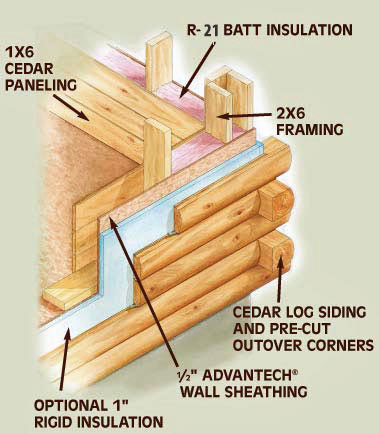
Siding and insiding. Visually, it has the look and feel of one while having the ability to stand up to the cold.That’s not really a log home though. That’s log siding.
My wife grew up in a large log home made of chestnut. It was dark on the inside and walls were dust collectors, so I might opt for brighter and easier to clean walls, especially in an area with 3 hrs of winter daylight.
There's also hybrids log homes which can have up to R30 walls.
Hybrid & Timber Homes
Discover hybrid log homes that blend cedar beauty with modern energy efficiency. Customize any Ward design for your perfect hybrid or timber home.
I’m not going to disagree that it’s a good, even great, alternative, but even they are calling it log siding, not a log home.
True log homes can be a bear with things like bats, and wood boring insects. The siding could eliminate many of those issues. We have literally worn out electric caulk guns on them. 1 log duplex physically ate 2 brand new Ridgid caulk guns, lol.
True log homes can be a bear with things like bats, and wood boring insects. The siding could eliminate many of those issues. We have literally worn out electric caulk guns on them. 1 log duplex physically ate 2 brand new Ridgid caulk guns, lol.
I’m not going to disagree that it’s a good, even great, alternative, but even they are calling it log siding, not a log home.
True log homes can be a bear with things like bats, and wood boring insects. The siding could eliminate many of those issues. We have literally worn out electric caulk guns on them. 1 log duplex physically ate 2 brand new Ridgid caulk guns, lol.
The cool thing about log homes is the actual floor plans typically used. Lofts, tall ceilings, steep pitches. For whatever reason, stickbuilt homes are much more boring. Logs seem like a horrible choice for a building material. You can custom build anything but it just doesn't happen much. I noticed this when looking for a house to move to in various states. Log homes were always cool homes but the problem is they use logs!
ICF seems like a good idea, it's a little more expensive upfront but, saves money in the long run with better insulation.@ Log Home,
Yes you should ask your builder about insulation for your log cabin. I think they can build 'phony' interior walls in log cabins that can be stuffed with insulation/or foam board used. This is similar to stick frame builders who do the double wall system. If I was building in interior Alaska I would consider insulated concrete forms - if there is a manufacturer in Alaska, else it would probably be too expensive.
Or you can putlog cabin siding on an ICF house.
Yes, better insulation and better sealing = lower heating losses.ICF seems like a good idea, it's a little more expensive upfront but, saves money in the long run with better insulation.
A friend of mine builds entire houses with them here for the exteriorYes, better insulation and better sealing = lower heating losses.
A reliable abundant affordable heat source in a very cold area where someone will be living in is obviously one of the top priorities along with proper insulation. The more I do reading into anthracite coal availability in Alaska, it's quite clear it's not an option.
I been calling around anthracite coal producers/distributors and most do not ship to Alaska. Anthracite coal stoves are rare in Alaska for a reason. The idea of a coal stove was a good idea only for it's performance but, it's just not practical in Alaska, it's not widely available. It's a shame since they have such long burn times and low maintenance. I contacted Blaschak Anthracite one of the top producers of anthracite coal and they do not ship to Alaska. So, a anthracite coal stove is out of the picture. Back to the Blaze King King 40.
The question is, is one Blaze King King 40 sufficient to heat the cabin or should a smaller second wood stove be installed in the corner of the first floor or hallway on second floor?
Is there a way to get even more performance out of that Blaze King by having brick or stone built around the stove on the floor and wall within reason ? The brick or stone can also add to the appearance.
Highbeam, your 200 square foot wood shed that holds 11 cords is a good idea and something I've thought about for a while, I just didn't know how big it had to be to hold that many cords of wood but, knowing that your shed can hold 11 cords has given me a lot of confidence.
I been calling around anthracite coal producers/distributors and most do not ship to Alaska. Anthracite coal stoves are rare in Alaska for a reason. The idea of a coal stove was a good idea only for it's performance but, it's just not practical in Alaska, it's not widely available. It's a shame since they have such long burn times and low maintenance. I contacted Blaschak Anthracite one of the top producers of anthracite coal and they do not ship to Alaska. So, a anthracite coal stove is out of the picture. Back to the Blaze King King 40.
The question is, is one Blaze King King 40 sufficient to heat the cabin or should a smaller second wood stove be installed in the corner of the first floor or hallway on second floor?
Is there a way to get even more performance out of that Blaze King by having brick or stone built around the stove on the floor and wall within reason ? The brick or stone can also add to the appearance.
Highbeam, your 200 square foot wood shed that holds 11 cords is a good idea and something I've thought about for a while, I just didn't know how big it had to be to hold that many cords of wood but, knowing that your shed can hold 11 cords has given me a lot of confidence.
Similar threads
- Replies
- 23
- Views
- 1K

- Replies
- 1
- Views
- 3K

- Replies
- 10
- Views
- 402

- Replies
- 23
- Views
- 381

