
VC Intrepid Flexburn Woes / Help Diagnosing burn/smoke issues

  • Active since 1995, Hearth.com is THE place on the internet for free information and advice about wood stoves, pellet stoves and other energy saving equipment.

    We strive to provide opinions, articles, discussions and history related to Hearth Products and in a more general sense, energy issues.

    We promote the EFFICIENT, RESPONSIBLE, CLEAN and SAFE use of all fuels, whether renewable or fossil.

Wannabe

New Member
Oct 23, 2026
8
Massachusetts
Hi there,

We've had our VC Intrepid Flexburn for 3 seasons now and it's been really finicky/hard to maneuver. It's a long shot, but if anyone has dealt with similar and/or can see the pattern in the issues, any advice would be amazing!

Our primary issue has been around smoke/smouldering. From most to least concerning:

1. The smoke is much thicker coming out when the damper is closed; even if the cat probe (oem) reads hot enough, the stove is hot (600-800STT), and there's a healthy ember bed. Removing the damper almost immediately produces less smoke. I'm worried about creosote buildup (and/or annoying the neighbors, it's thick and descends into yards). Our wood should be dry enough (seasoned 2yr+), but a moisture meter is in the mail to confirm
- Found this similar thread that pointed to wet wood

2. The air intake control doesn't seem to have much effect when the damper is open. It does something, but the fire will build up to 800 STT if there's fuel even with the least intake. This is frustrating because we are forced to use the damper to prevent overheating, which has the aforementioned issues. Maybe this is by design The air intake does seem to work OK (but not perfect?) when the damper is on.
- Related thread but not explicitly about open damper

3. The stove can sometimes spill smoke when starting up / I have to take care to burn some newspaper close to the liner to establish a "path", and even then I worry if it doesn't immediately catch

4. The glass gets hazy within minutes of firing up and has established black buildup even after a couple hours burn (always in the same places where the air flows radiating out from the edges of the glass)
- Related thread says this is a leak and/or bad design

Now (1) is a puzzler because it seems to be having the opposite effect that I'd expect from a secondary burn. It's possible our cat has died due to age/overheating, but even without it, I'd expect some reduction based on reading the manual. Or am I misunderstanding how secondary burns work?

It feels like so many things could be wrong--maybe it's a drafting issue (3's smoke feels like bad draft), or a leaky gasket cooling the smoke before it exits, or a bad cat. It's worth mentioning it's a stainless steel liner (unknown if insulated) with a T-shaped connection to the back of the unit (the collar faces back instead of up). I wouldn't rule out a bad install either, the installers had no idea what they were doing.

Sorry this became so long; I so desperately want this to work. I grew up with a wood stove and loved it dearly, but this VC has been nothing but trouble.

Thanks for your time and help!
 
You make no mention of the chimney, probably information the experts will want to know. Details like diameter, length, type, last time it was swept, number of bends and the angle of the bends(if any).

How old is the CAT and how many hours of use has it had? Once your moisture meter arrives post your test results.
 
Have you tried the dollar bill test to check your gasket integrity?

Is the liner insulated? When you had the liner swept, what came out?

How was the wood stored while drying? Does the stove act differently if you burn a load of kiln dried 2x4? Some species available to you in Mass are going to take over 2 years to fully let the water out! The meter will be able to rule out a big variable!

And lastly VC stoves have a finicky reputation!
 
Thanks all for the responses! I've answered inline below:

Details like diameter, length, type, last time it was swept, number of bends and the angle of the bends(if any).

It's a 6" stainless steel liner; I don't think it's insulated other than right at the base (but I was under the impression that was more to keep cold air from coming down). It rear vents 10" mostly horizontal (angled down slightly) into a T connection where it turns 90deg up a brick chimney, about 16-18 feet or so.

How old is the CAT and how many hours of use has it had?
CAT was has been through 2 burn seasons now; Roughly 1 cord of wood between the two.

Have you tried the dollar bill test to check your gasket integrity?
I just did it; I could pull it out of the top edge of both doors, but it was snug there / gave good resistance. The top right of the ash tray however could be pulled out without much at all. The hinge side is tight. Damper would have ripped the bill. I'm not sure if it's a significant enough area of looseness to matter? I know cracking the ash tray even a bit will really cause the fire to take off, so it could be something.

When you had the liner swept, what came out?
A LOT of creosote came out; to the point where the sweep said it looked like a chimney fire might have occurred. This was after our first season and the wood had just been delivered; I highly suspect it was too wet that season, but at the time I thought we were just burning too low (following the rough STT guidelines, keeping it ~500).

How was the wood stored while drying? Does the stove act differently if you burn a load of kiln dried 2x4?
We got the wood from a local tree guy who claimed it was seasoned; I'm pretty sure he doesn't have all of his seasoning wood covered (just based on driving by), but hard to know. I'll try to pick up some dried wood from a box store soon and test this; definitely something I should have tried sooner! (a bit of denial haha; "I spent $$ on this wood, it must be good!")
 
Last edited:
I did have a crazy theory today though--I wonder if we're burning too hot. I was so scarred by the smouldering/a backpuff incident/the creosote on sweep that I thought we must be burning too low. This season I was letting it get to 750STT before engaging the damper (which would then slowly get down to 650 before climbing back up a bit usually).

My understanding is the air flow control doesn't directly control the air intake in a 1-1 ratio but instead uses a thermometer to try to maintain a constant heat output. As I mentioned in the top post, it does nothing to stop the undampened fire from getting to 800STT, but I wonder if when I dampen it at 750STT the thermometer says "woah too hot" and intentionally smoulders the fire, causing the "more smoke with the CAT" behavior that I'm seeing.

Does that sound rational? Or am I seeing ghosts? Tis the season :)
 
The stove vents out the back and goes slightly down?

Is the ash door latch side adjustable?
 
The stove vents out the back and goes slightly down?
Yes, although the "slightly down" was a bit of an optical illusion. Measured with a phone level today somewhere between 0-5deg downward, so not severe.
Is the ash door latch side adjustable?
Ah yes it is! I tightened it with good results for the dollar bill trick before todays burn, but alas it didn't have much affect on either the undampered fire "taking off" to 800STT regardless of air control or the dampered fire producing significantly more smoke :( This happened at ~650STT today with the mechanical CAT probe reading a healthy bit into the "operating range" area, so I'm not sure what gives.
I hope you realize that when your loading or tending the fire with the damper closed that your supposed to open it in bypass before you open the stove door..
Thanks for chiming in! Yes, we open it whenever tending to the fire / refueling (and let it catch for 5-10m before reclosing)
 
  • Like
Reactions: Burnin Since 1991
How tall is your chimney? Do you have any structures that could shape the wind by the chimney? Trees, house parts less than 10 feet away? Really windy area?
 
  • Like
Reactions: Burnin Since 1991
Yes, although the "slightly down" was a bit of an optical illusion. Measured with a phone level today somewhere between 0-5deg downward, so not severe.

Ah yes it is! I tightened it with good results for the dollar bill trick before todays burn, but alas it didn't have much affect on either the undampered fire "taking off" to 800STT regardless of air control or the dampered fire producing significantly more smoke :( This happened at ~650STT today with the mechanical CAT probe reading a healthy bit into the "operating range" area, so I'm not sure what gives.

Thanks for chiming in! Yes, we open it whenever tending to the fire / refueling (and let it catch for 5-10m before reclosing)
It sounded like in the original post that you were opening the door with the bypass closed.

So if your getting smoke coming out of the stove during a reload that's more of a draft issue.

Check the moisture of your wood as that will cooling the stovepipe killing draft

An insulated liner to help with draft.
 
  • Like
Reactions: Burnin Since 1991
The air intake does seem to work OK (but not perfect?) when the damper is on.
When the bypass is closed the air control level should significantly change how the fire is behaving.
If you close the bypass and shut the air control fully and the fire is still really active, fast moving yellow flames with a rising STT, I would start looking for an air leak.

I had success with a stick incense from the grocery store. Light it and run it over all the gaskets and seams while the stove is running, the smoke will get pulled into any air leaks.

We got the wood from a local tree guy who claimed it was seasoned
Yea I think I've met that guy, isn't it amazing how he can chop down a tree on Tuesday and have it seasoned for two years by Friday?

The amount of smoke you're describing is odd, I think you're already on the right path with trying wood from a different source and getting a moisture meter.
 
It rear vents 10" mostly horizontal (angled down slightly) into a T connection where it turns 90deg up a brick chimney, about 16-18 feet or so.
Get the Auber digital probe, it will really tell you what your cat is doing, that analog gauge causes more issues it seems like, black heavy smoke tells me the cat hasn't lit off.

I think you are having issues with draft due to a short chimney . You stated 16-18' overall height but with the 90 typically you would take 3' off the overall height to be an effective height of 13-15'. per the install manual (page 10 link below) that stove was designed around a 16' height.
https://downloads.hearthnhome.com/installManuals/3-90-30007345i_Intrepid_FlexBurn_Install.pdf

I would look at what it would take to add 3' or more section to your chimney height, hopefully there is a mount at the top of the chimney you could do this. I know adding extra/ the correct amount to my Encore has really made for a better draft and I have two 90's in mine.

other note, my ceramic cat from VC only lasted me a year (2-3 cords of wood) replaced with a metal cat and its has been running great for 2+ seasons.
 
Last edited:
  • Like
Reactions: Burnin Since 1991
Thanks all for weighing in! To not bury the lede, moisture meter came in and I chopped a few different pieces and they all clocked in around 15% moisture, which supports the theory that a couple years ago they were wet / the cause of the "looks like a chimney fire" amount of creosote... but doesn't explain the CAT smokiness now.

My main confusion I still have is that with the damper closed, the opacity is MUCH worse. It's not black smoke by any means but it's thicker/heavy and the minute I undo the damper it clears up. I've attached a quick video of the smoke. It was a few days ago, but if my memory serves it was ~45F out at the time and STT was likely ~750 with the CAT probe in a healthy range (although I hear ya on the Auber rec--that's a good next step).

You stated 16-18' overall height but with the 90 typically you would take 3' off the overall height to be an effective height of 13-15'
Sorry for the confusion, I attempted to adjust for this in my measurements. I clocked the chimney at ~22-24ft IIRC and then took off ~5ft to account for how high the stove is off the ground. I can try to get a better measurement.

So if your getting smoke coming out of the stove during a reload that's more of a draft issue.
To clarify, this is less of an issue (past the initial cold start, but the more I chat with folks the more I hear this is common once a season or so to be smoked out, which matches our frequency, just really spooked me!).
 

Attachments

  • IMG_0870.MOV
    7.3 MB
  • Like
Reactions: Burnin Since 1991
Maybe walk us through your start up to when you are closing your dampener.

Mine: (cold start)
-Assembly 2 small quarter splits on bottom with newspaper in the "channel" between the splits, then add a stupid amount of kindling because that's how I was raised, then a 2" flat split over the top.
- 20-30 seconds with propane torch aimed up through dampener to warm the chimney
- light fire - air and dampener wide open for roughly 30-45 minutes (good amount of smoke in the burn chamber before the draft really starts up.
-once stove top (not griddle) gets around 500, Auber digital probe shows rear combustion chamber warming to around 100, close dampener to engage cat.
- temp will rise to around 600, brief stall around this temp - then cat gets going and I start dialing air back around 900 on cold start up (800 on warm reload)
 
The smoke in the picture doesn't look terrible.. black or blue color is really not good. Yours is kinda white.

How often do you clean your cat and definitely go alber for real time data

As for startup I pretty much get 0 smoke

2super small splits like 1.5x1.5

In the middle in-between I use small twigs from branches that have been collected over the year

On top of the 2 splits I use 6super small kindling pieces stacked Jenga style 2 on 2 on 2
The pieces used are roughly 1x1 or smaller and roughly 6/8 inches in length

Take a torch and light the twigs and let it rip

Door stays cracked for 10 minutes if that.

As for your glass it will get discoloration.. there's not real way around that if your cutting your air your going to make the fire smolder some.. that is the fuel the cat is burning off.

After an overnight burn my glass looks bad.. I just crank the stove up in the morning and burn it off.
 
once stove top (not griddle) gets around 500
Wait.. at this point what does your griddle read? I've been reading from the griddle because the User Manual was pretty explicit that that was the right spot:
Figure 2.8 - Take temperature readings with a thermometer located
in the middle of the griddle.


How often do you clean your cat and definitely go alber for real time data
I kinda gently give it a tap once a season, but I should probably vacuum it (or any other tips?).

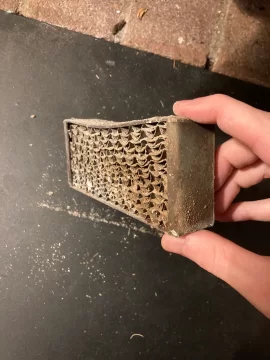
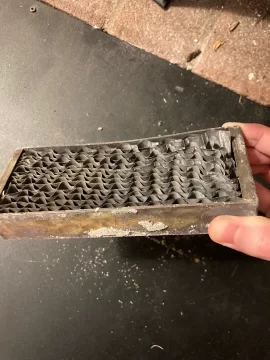
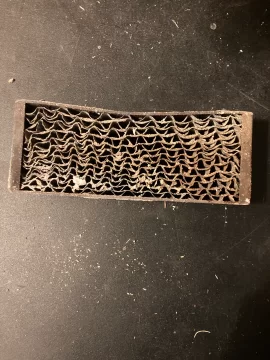
I'm starting to wonder if maybe I just need a new CAT. Mine doesn't look super gunked up, but it's definitely got some build up on the front and one of the metal wafers is popping out the back... (pics attached).

I'm thinking maybe I burnt wet wood my first season and clogged it? What do y'all think--does this look clogged? Or just mild buildup?


Maybe walk us through your start up to when you are closing your dampener.
It's been a few days, and I've only done 5-10 burns this season, but here's my best approximation:

I typically do a top-down burn. One layer of 2" kindling on the bottom, then 1-1.5" layer with some thin cardboard, then a .5" layer with newspaper, then I pile a bunch of twigs and small sticks from yard cleanup on top. I light a piece of newspaper and hold it up to the open damper for 15-30s to establish the draft (with an open window nearby), then light the newspaper and let it rip. I cheat a bit at first and open the ash tray a crack (rather than cracking the door) for 30-60s to get it really caught/derisk smoking into the living room.

I'll let that burn fully until the 2" kindling is half gone, then pile some more 2" kindling on that to get a better ember bed. Wait until it's half gone and then 3 x 3" small logs on that. Let that burn down until it's embers, and then I'll start loading 4" logs or so--never anything much bigger than that. It's when I start loading the 4" logs (~1hr into burn time) that I'll try to close the damper; and only then if I have a good ember bed. The griddle temp is usually 750 at this point (sometimes I have to engage the damper for a minute to get the 3" logs to edge away from 800+, since the air flow doesn't really do much without the damper).

I'm generally really cautious about having a big enough ember base / the reloads being caught enough (5m or so per reload) before engaging the damper (due to the chimney sweep finding so much creosote). If I ever see the flames go out, I immediately open it; but the white smoke happens even when it's happily flaming in the firebox.. maybe not so much with the "roar" of secondary combustion (I hear that when I first hit the damper but it only lasts a minute or two before it calms down).

Sorry if I'm being a broken record; it just feels like the CAT is doing the opposite of what it should (reduce opacity)... maybe the CAT is the obvious culprit?
 

Attachments

  • [Hearth.com] VC Intrepid Flexburn Woes / Help Diagnosing burn/smoke issues
    IMG_0903.webp
    344 KB · Views: 17
  • [Hearth.com] VC Intrepid Flexburn Woes / Help Diagnosing burn/smoke issues
    IMG_0904.webp
    389.3 KB · Views: 16
  • [Hearth.com] VC Intrepid Flexburn Woes / Help Diagnosing burn/smoke issues
    IMG_0902.webp
    611.2 KB · Views: 15
  • Like
Reactions: VRB Farm
That does not read like a top down.
A top down is splits on the bottom, smaller splits on top, kindling and fire starter (paper, noodles, n whatever) on top.

I would order a new cat. Keep this one; if the new one behaves the same maybe the current one isn't bad.

What newspaper do you use? Black and white only is best, as colored ink can contain stuff that poisons cats.
 
That doesn't really sound like a top down. Here is a picture of the way I start that doesn't produce smoke.

Your cat is toast.. your using a metal cat which is great. I vacuum mine probably once a month or so when I clean out the ash. You should work on keeping the cat clean that is what is burning off the smoke. Also it's keeping your draft up when your burning low temperatures
[Hearth.com] VC Intrepid Flexburn Woes / Help Diagnosing burn/smoke issues
 
agreeing with the above on the cat looking toast but to hold onto it.

Other thing - we are in the shoulder season - so poor drafts are common this time of year depending on outside temps, and I believe you all just had a week of wet low pressure, so keep an eye on what your outside temps/conditions are when lighting off. (ex- NW NJ and south central CT guy here - now in the Midwest...)

I also recommend a propane torch for getting your chimney draft started vs the paper, propane burns around 2000F, paper around 450-1000 (thanks google robots). So much faster to get things flowing, no smoke, click on click off. Small green camp bottle with a torch head with built in ignitor, think I have over 2 years on the one I am using.

I'm probably the outlier on where I place the inaccurate reading devices, I have two either side of the griddle towards the back, I personally feel this give me a more accurate reading of what the stove is doing. When I had a single on the griddle I felt like I was over firing the stove on every burn; but I actually wasn't close to temps needed, analog cat gauge as well didn't help since it would read acceptable, during this time had issues with major build up in my chimney as a result.

When I moved to these locations I could tell what side of the fire has active flames vs ember bed (just throwing numbers out here, 300 on one side and 500-600 on the flame side - average out the two ~450ish). I use these gauges to get the stove started and that's about it, then it is all about the Auber digital in the back. The gauges are so inaccurate as other have mentioned in the past, you can see the variance in the "cold" photo below. once they break the 400-500 mark on both sides I know I am good to go. Next burn I do I will get out the IR gun and see how they all compare to griddle temps, it will be bit since we are mild temperatures for a good bit and harvest is still dragging on.
.
[Hearth.com] VC Intrepid Flexburn Woes / Help Diagnosing burn/smoke issues
 
When I had a single on the griddle I felt like I was over firing the stove on every burn; but I actually wasn't close to temps needed, analog cat gauge as well didn't help since it would read acceptable, during this time had issues with major build up in my chimney as a result.
This resonates a lot! I've always wondered if the griddle temp was inaccurate / not as good a gauge as the manual implies...

Thanks all for the input on the CAT -- I'll look into getting a new one ASAP. Is OEM best? Or do folks have preferred after market vendors?

Just as a sanity check, can someone confirm that for the Auber CAT probe I want the AT100TC/WRNK-191(6")?
 
Midwest Hearth has cats for good prices


I’m interested to see your cat temps once you have the probe installed. Having the real time feed back really helps dial in the burns.
 
This is sort of a perplexing issues, the 750-800 STT is very hot for a VC and I would consider that an over fire, with risk of cracking / warping the stove. That’s probably why your cat is toast (over heated catalyst too many times).

So I wonder if you’re fighting two issues, excess smoke and overfiring the stove / unresponsive air control?

Is that video the “bad” smoke?! On my VC encore I get a little smoke (more than that sometimes on the startup (CAT bypass not engaged), then once it’s up and gong it’s burning clean. Usually by STT 450 the stove is ready for the CAT to be engaged, often on engagement I’ll get meandering smoke like that for a few minutes and then the smoke is gone and it burns clean for hours. If the smoke gets worse it’s because I engaged the CAT too soon and it didn’t activate the catalyst. In a fail to activate the CAT scenario, i disengage the CAT, burn it hotter for 5-10 min and try again.

Note I burned most of the last week in MA and didn’t have any noticeable draft / smoke issues. Admittedly early fall and late spring can cause draft / CAT activation challenges; but again I didn’t experience any this past week.
 
  • Like
Reactions: VRB Farm
Midwest Hearth has cats for good prices
2X agree with this, and good customer service when needed.

Agreeing with Turbo about the 750-800 is very hot. I think the trick/mastering of this stove is knowing hot coal temps vs hot flame temps on start up. I could start a fire with Poplar and have griddle temps up in no time, but there would be no coal bed to support the CAT. I still don't have personal confidence in myself to load my stove to gills on start up and be able to know how to control it comfortably. So small/med 3 split start gets me the coal base to start the cat up with enough fuel get me to a reload. I work from home so this extra tending isn't an issues for me. Everyone will have a different process, but I will say there is a ton of knowledge on this site that I have learned copious amounts from; many of whom I consider experts are on this thread.

sensor setup looks correct, I'm not familiar with the back of your stove but I would think a 6" probe would be enough.

-A question that hasn't asked is what type of wood are you burning?

These stoves love Oak, I have found poplar to be good for quick warm up/start up fires but very little coaling, Silver Maple does well- burns well for me, certain ASH gets my cat overly excited (probably high moisture that I didn't check). Next year I will be adding Black Walnut and hickory to the list since the logging company topped a ton of these out of my neighbors woods that I just got split late this summer.
 
Last edited:
  • Like
Reactions: Wannabe and Turbo89
This resonates a lot! I've always wondered if the griddle temp was inaccurate / not as good a gauge as the manual implies...

Thanks all for the input on the CAT -- I'll look into getting a new one ASAP. Is OEM best? Or do folks have preferred after market vendors?

Just as a sanity check, can someone confirm that for the Auber CAT probe I want the AT100TC/WRNK-191(6")?
Me personally id stick with the manual suggestion and take the temperature off of the griddle. I keep 2 on mine

You can get you cat off of Amazon the Midwest hearth is the exact same cat that came with the stove both are made by the same manufacturer.
 
  • Like
Reactions: Turbo89
2X agree with this, and good customer service when needed.

Agreeing with Turbo about the 750-800 is very hot. I think the trick/mastering of this stove is knowing hot coal temps vs hot flame temps on start up. I could start a fire with Poplar and have griddle temps up in no time, but there would be no coal bed to support the CAT. I still don't have personal confidence in myself to load my stove to gills on start up and be able to know how to control it comfortably. So small/med 3 split start gets me the coal base to start the cat up with enough fuel get me to a reload. I work from home so this extra tending isn't an issues for me. Everyone will have a different process, but I will say there is a ton of knowledge on this site that I have learned copious amounts from; many of whom I consider experts are on this thread.

sensor setup looks correct, I'm not familiar with the back of your stove but I would think a 6" probe would be enough.

-A question that hasn't asked is what type of wood are you burning?

These stoves love Oak, I have found poplar to be good for quick warm up/start up fires but very little coaling, Silver Maple does well- burns well for me, certain ASH gets my cat overly excited (probably high moisture that I didn't check). Next year I will be adding Black Walnut and hickory to the list since the logging company topped a ton of these out of my neighbors woods that I just got split late this summer.
It took me a while to tame my encore, i eventually partially blocked the secondary air; after replacing the door and griddle gasket, now the stove is much more tame / controllable. Now I can stuff it to the gills, and do most nights, without fear of it running away. I burned a lot of full loads of ash / maple last winter without overheating it. If you’re having issues still you may try that, my stove will burn anything now and has become quite reliable and consistent.

Once the OP gets a good CAT temp probe I’m sure we’ll be able figure out what’s going on. I’m suspicious most of his issues are related to how he’s operating the stove; and separately I’m suspicious that he has a very strong draft.
 
  • Like
Reactions: Wannabe